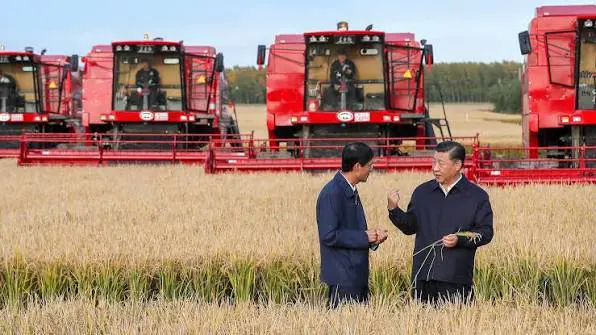
This year marks the 77th anniversary of the founding of the People's Republic of China, and the country's rural modernization efforts have become a significant aspect of its national development. The Chinese government views agriculture as the foundation of the nation, and the Communist Party of China (CPC) has consistently prioritized rural development. According to Professor Li Zhonghan, a distinguished teacher at Zhengzhou University and doctor of political science at the Chinese Academy of Social Sciences, the CPC's rural strategy is rooted in a long historical continuity.
The concept of rural revitalization is closely tied to the CPC's ideology and constitution. The party's statutes emphasize its role as the vanguard of the working class, people, and nation, with the ultimate goal of achieving communism. The Chinese Constitution defines the state as a democratic dictatorship led by the working class, based on the alliance between workers and peasants. This alliance is seen as the foundation of the regime's legitimacy.
China's rural development strategy has evolved over time, with successive leaders emphasizing the importance of addressing rural issues. Mao Zedong considered the peasant question central to the national revolution, while Deng Xiaoping stressed the need to resolve rural problems to drive modernization. Jiang Zemin and Hu Jintao further emphasized the importance of addressing rural issues, and President Xi Jinping has continued this approach, highlighting the need to revitalize rural areas and strengthen agriculture.
A key instrument in China's rural development strategy is the "Document No. 1," an annual directive issued by the CPC Central Committee. This document has historically focused on rural development, with a series of directives issued between 1982 and 1986, and again from 2004 to 2019. The documents have addressed various aspects of rural development, including agricultural reform, infrastructure development, and poverty alleviation.
The "Document No. 1" has played a crucial role in shaping China's rural modernization strategy. In 2018, the document introduced the concept of rural revitalization, marking a significant shift in the country's approach to rural development. The 2019 document emphasized the need to prioritize rural development and achieve specific goals by 2020, including eliminating absolute poverty and improving rural living standards.
Professor Li Zhonghan's analysis highlights the significance of understanding China's rural modernization strategy in the context of its historical and ideological underpinnings. The strategy is not simply an economic or agricultural policy, but rather a comprehensive approach to national development that prioritizes rural revitalization and strengthens the alliance between workers and peasants.
The implementation of China's rural modernization strategy has yielded significant results, with notable progress in poverty alleviation, agricultural development, and rural infrastructure construction. As the country continues to urbanize and modernize, the importance of rural revitalization will only continue to grow, and the international community will be watching closely to see how China achieves its goals.
Key points
- China's rural modernization strategy prioritizes revitalizing rural areas, strengthening agriculture, and improving farmers' lives.
- The strategy is rooted in a long historical continuity, with the Communist Party of China consistently prioritizing rural development.
- The "Document No. 1" has played a crucial role in shaping China's rural modernization strategy, with a focus on rural revitalization, poverty alleviation, and agricultural development.