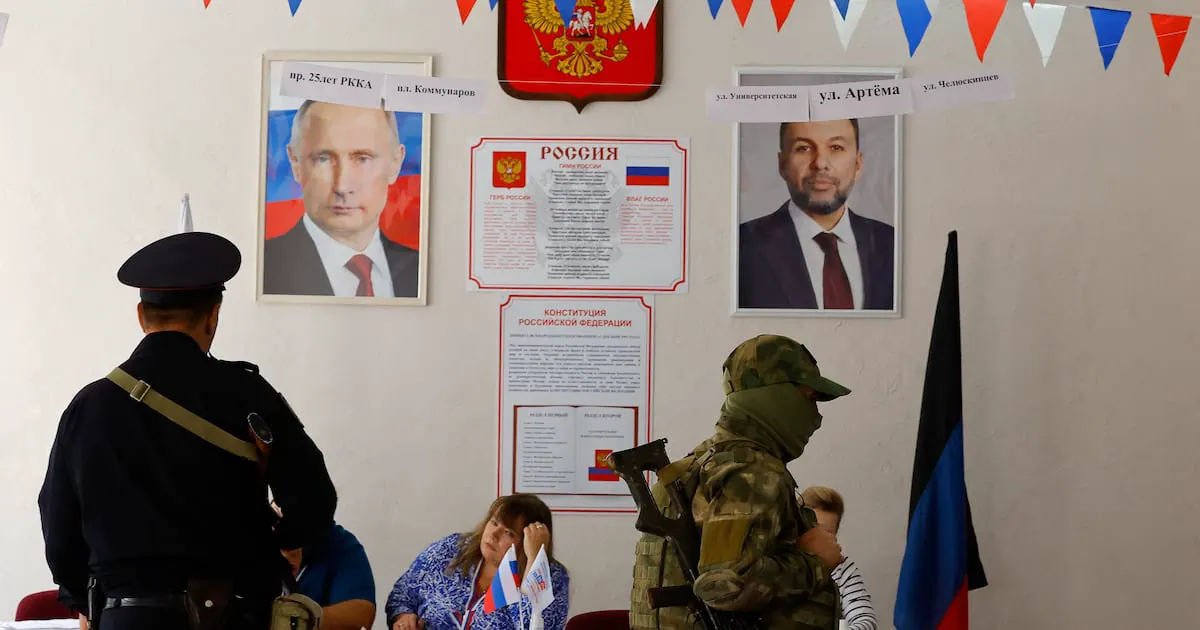
The pro-Putin United Russia party has retained its majority in the national parliament, according to near-complete election results. This development is expected to strengthen Putin's position, having framed the election as a test of support for the war in Ukraine. With a tight grip on Russia's political system, Putin is likely to use the results to argue that most Russians back his decision to continue fighting until key war aims are met.
The war in Ukraine has had significant effects on Russia, including Ukrainian drone strikes on Russian territory and fuel shortages caused by strikes on oil refineries. As a result, some Russians are increasingly anxious, and Putin may use the election results to reassure them that the country remains stable. By pointing to the success of veterans who fought in Ukraine and are now entering parliament, Putin can demonstrate how Moscow rewards those who have risked their lives for the country.
Putin has repeatedly questioned the legitimacy of Ukrainian President Volodymyr Zelensky, citing the expiration of Zelensky's term in May 2024 and the absence of new elections. In contrast, Russia has stuck to its electoral timetable despite the war, allowing citizens to vote. This contrast may be used by Putin to portray Russia as a more democratic country than Ukraine, potentially undermining Zelensky's authority.
The Russian government has been keen to show that life can continue as normal despite the conflict. The relatively smooth parliamentary election across 11 time zones demonstrates that pre-war practices are being respected. However, critics fear that the authorities may deploy more repressive measures now that the election is over, including potential mobilisation to expand the ranks of the Russian army in Ukraine.
Western intelligence agencies have reported heavy Russian losses on the battlefield, and Moscow is eager to speed up its territorial gains. Critics worry that Putin may use the election results to justify mobilisation or increased censorship. Plans to charge customers extra for using more than 15 gigabytes of foreign data in a month have been floated, which could target individuals using VPNs to access banned websites and apps.
The success of around 200 veterans who stood for election from various parties is likely to be cited by Putin as an example of how Moscow rewards those who have served in Ukraine. This could encourage more people to sign up to fight in Ukraine, as Putin has promised prestigious careers for those who have risked their lives for the country. The creation of a "new elite" comprising war veterans may become a key aspect of Putin's post-election strategy.
As the fifth year of the war in Ukraine begins, Putin's government is facing increasing challenges in maintaining a sense of normality. Despite the difficulties, the Russian government has demonstrated its ability to hold a relatively smooth parliamentary election while waging war. The outcome of the election is likely to be used by Putin to reassure Russians that the country remains stable and that life can continue as normal, despite the ongoing conflict.
Key points
- Putin may use the election results to justify continued war efforts in Ukraine and reassure Russians that life goes on despite the conflict.
- The success of war veterans in the election may encourage more people to sign up to fight in Ukraine.
- The contrast between Russia's and Ukraine's electoral processes may be used by Putin to portray Russia as a more democratic country.