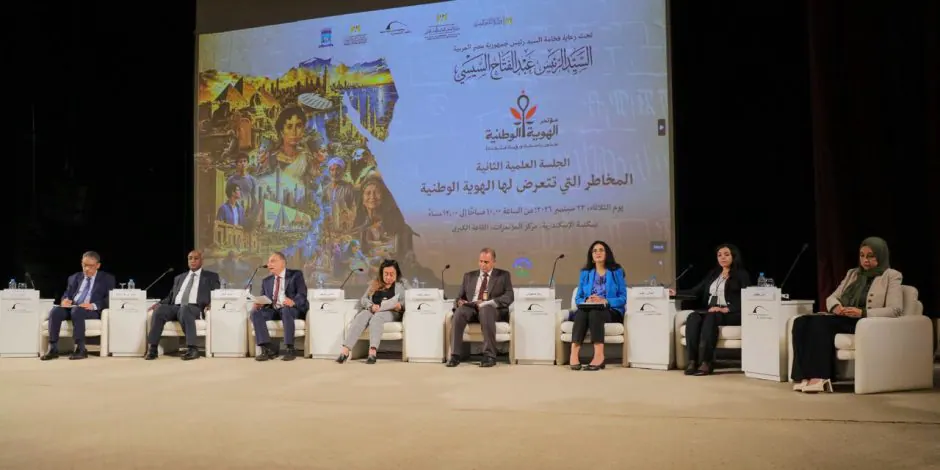
A session titled "The Risks to National Identity" was held at the Alexandria Library as part of the "National Identity: Rooted and Renewed Vision" conference, under the auspices of Egyptian President Abdel Fattah El-Sisi. The session was led by Dr. Mohamed Kamal, a professor of political science at Cairo University and head of the Foreign Affairs Committee in the Senate. Participants included Dr. Diaa Rashwan, Minister of State for Information, and Ambassador Mohamed Abu Bakr Saleh, Deputy Foreign Minister.
Dr. Diaa Rashwan discussed the anthropological concept of identity, describing it as a comprehensive way of life that includes details of food, clothing, traditions, and body language. He emphasized that there is no scientific basis for the concept of "individual identity" and that Egypt is a "state of a nation" that has extended for thousands of years. Rashwan also noted that the country's history has shown that changes in lifestyle only occur through military defeat and subjugation, which Egypt has been protected from throughout its history.
Ambassador Mohamed Abu Bakr Saleh highlighted the challenge of digital transformation, stressing that it lies not in the openness of digital space but in possessing awareness and critical thinking to deal with the flows of artificial intelligence and social networks. He outlined the roles of education, culture, media, religious discourse, and civil society in building awareness and consolidating values of diversity. Saleh also noted that the Egyptian diaspora has a strong sense of belonging and nostalgia for their homeland.
Dr. Mohamed Kamal emphasized that national identity is a cornerstone of national security and a component of the state's overall strength. He warned that the development of digital tools has led to the creation of parallel identities that seek to distort the minds of young people through digital algorithms that impose single perspectives. Kamal called for the formulation of an intellectual basis for the "idea of Egypt" to consolidate it in people's minds and education curricula.
Dr. Iman Ragab, head of the Military and Security Research Unit at the Al-Ahram Center for Political and Strategic Studies, discussed external threats to Egypt's national identity, highlighting that they target aspects of national belonging and state pride. She presented three executive recommendations, including conducting a national survey to measure the awareness of young people, establishing a national body to protect identity led by the Alexandria Library, and building national linguistic models using artificial intelligence.
Dr. Amal Moktار, an expert at the Al-Ahram Center, analyzed the intellectual underpinnings of the "Islamic politics" movement, emphasizing that its structural crisis lies in its rejection of the material framework of the state and the rule of law. She proposed three pillars for confrontation, including exposing and refuting historical fallacies, engaging young people in shaping a comprehensive Egyptian cultural project, and activating cultural integration.
The session also included interventions from Dr. Rim Bسيوني, a linguistics professor at the American University in Cairo, who discussed the linguistic aspect of national identity, and Dr. Walid Rashad, a sociology professor at the National Center for Social and Criminal Research, who emphasized the importance of preserving identity in the digital age. The speakers stressed the need for a comprehensive strategy to protect Egyptian identity and promote awareness and critical thinking among young people.
Key points
- The conference aims to promote awareness and critical thinking among young people to protect Egyptian identity.
- Experts stress the importance of education, culture, and media in building awareness and consolidating values of diversity.
- The session highlights the need for a comprehensive strategy to protect Egyptian identity from intellectual infiltration and digital space threats.