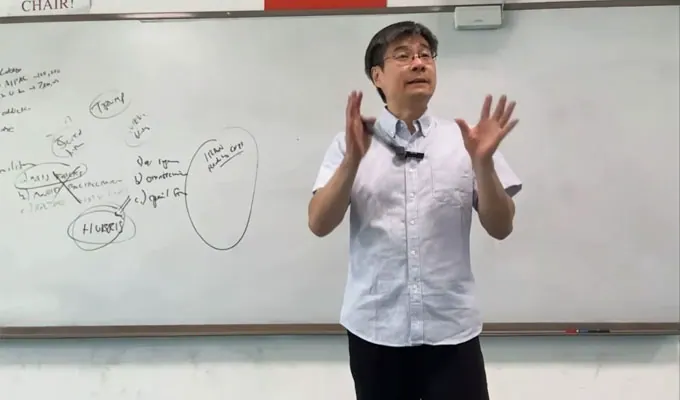
Professor Jiang Xueqin, known for his "Predictive History" method, has made several predictions about global events. His approach uses history, economics, and geopolitics to anticipate future scenarios. Some of his forecasts have already come true, while others remain to be verified. Jiang's predictions focus on the intersection of artificial intelligence, global finance, and geopolitics. His method aims to identify potential tensions before they escalate into crises. By analyzing current trends, Jiang provides a cartography of risks for economic decision-makers. His insights are considered valuable for understanding possible future developments.
Jiang Xueqin predicts that the artificial intelligence investment bubble will burst. He argues that massive investments in data centers and digital infrastructure are not yet supported by sufficient revenue. However, he also suggests that the US government may intervene to save strategic AI infrastructures. This intervention could prevent a complete collapse of the AI sector. Jiang's forecast highlights the risks associated with the rapid growth of AI investments. His prediction is based on the current imbalance between investments and returns in the AI sector. This potential crisis could have significant implications for the global economy.
Jiang Xueqin also warns about the risks associated with private credit. He estimates that a significant part of the US financial system relies on a mechanism that allows fragile companies to refinance and defer bankruptcies. This market is valued at around $2,000 billion, which is comparable to the imbalances that preceded the 2008 financial crisis. Jiang's prediction suggests that the private credit sector may be vulnerable to a crisis. His analysis highlights the potential risks of a large-scale financial crisis. The similarity with the 2008 crisis is a cause for concern among economists and financial experts.
Another prediction made by Jiang Xueqin concerns a potential US debt crisis. He forecasts that the increasing difficulty in attracting buyers of Treasury bonds could push US interest rates to 6% or more in 2026-2027. This development could have significant consequences for the financing of the economy. A US debt crisis could have far-reaching implications for the global economy. Jiang's prediction is based on current trends in the US debt market. His analysis suggests that the US government may face challenges in managing its debt.
Jiang Xueqin also predicts that Japan may regain its status as a major strategic power in East Asia. He argues that Japan's resurgence could be driven by energy and geopolitical risks. In his recent analyses, Jiang suggests that Japan, rather than China, may be a candidate to establish a new regional sphere of influence. This prediction highlights the potential for a shift in the regional balance of power. Jiang's analysis is based on current trends in East Asian geopolitics. His prediction suggests that Japan may play a more significant role in regional affairs.
Jiang Xueqin's predictions also focus on the future of artificial intelligence. He forecasts that AI will become a strategic infrastructure protected by the US government. In the event of a crisis in the sector, Jiang suggests that the US government may consider nationalizing large data centers. This prediction highlights the potential for a significant shift in the role of AI in the US economy. Jiang's analysis suggests that the US government may take steps to protect and control AI infrastructure. This development could have significant implications for the future of AI.
Jiang Xueqin's track record of predictions is mixed, with 16 correct and 6 incorrect forecasts out of 22 verified predictions. His approach is considered valuable for identifying potential risks and tensions. While his predictions are not always accurate, they provide a useful framework for understanding possible future developments. Jiang's method of "Predictive History" is considered a useful tool for economic decision-makers. His insights highlight the importance of monitoring current trends and potential risks.
Key points
- Professor Jiang Xueqin predicts that the AI investment bubble will burst and that the US may face a debt crisis.
- Jiang Xueqin's predictions also focus on the resurgence of Japan as a strategic power in East Asia and the potential nationalization of AI infrastructure.
- Jiang Xueqin's approach of "Predictive History" aims to identify potential tensions before they escalate into crises.