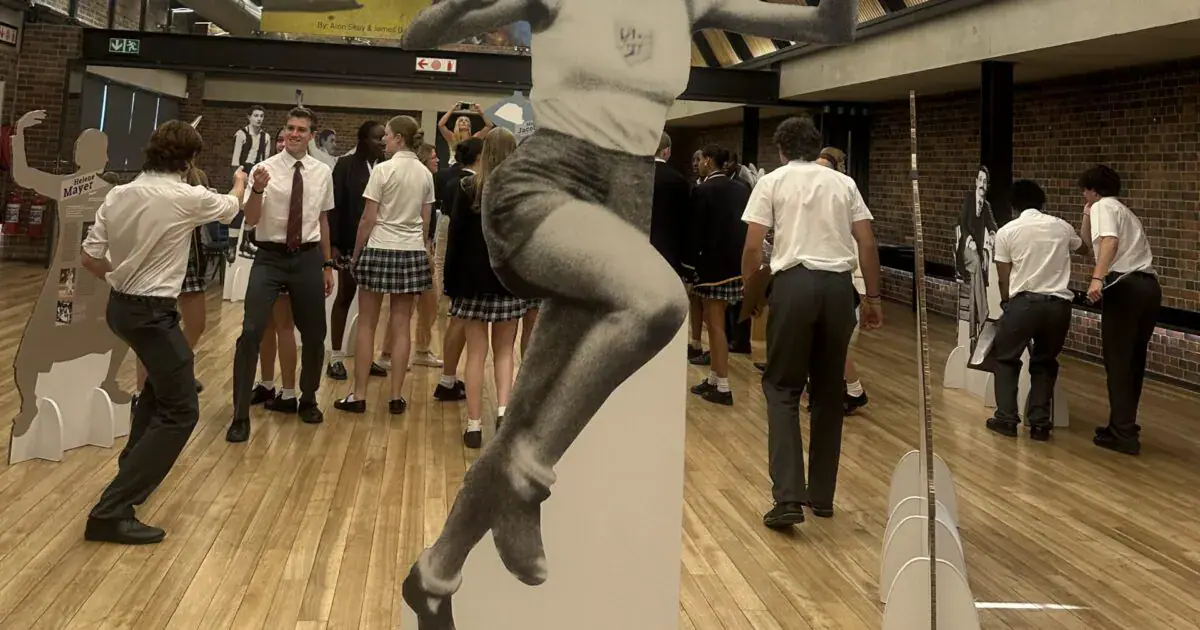
In the 1920s, Jewish athletes were a vital part of German sports, competing and breaking records with pride. However, with Hitler's rise to power in 1933, Jewish sportspeople were systematically excluded from clubs, competitions, and institutions. This forced many to abandon their sporting careers or flee Germany altogether. The stories of these athletes have been brought to Johannesburg through an exhibition at the Johannesburg Holocaust & Genocide Centre.
The exhibition, "Between Success and Persecution: Jewish Stars in German Sports Before 1933 and Beyond," features 15 German-Jewish athletes who were national team members, record holders, and world, European, and Olympic champions. Their sporting careers and lives were forever changed by Nazi persecution. Dr. Berno Bahro, a German sports historian and academic at the University of Potsdam, brought the exhibition to South Africa after working on it for about 10 years in Germany.
One of the athletes featured is Martha Jacob, a German-Jewish athlete who won her first competition at just six or seven and became Germany's national javelin champion at 18. By 20, she had become the youngest coach of the British Olympic squad, training athletes in 1931 and 1932. However, due to the rising antisemitic politics of the Nazi regime, Jacob left Germany for London in 1933 and eventually settled in Cape Town in 1936.
Jacob's daughter, Hazel Shore, spoke at the exhibition opening and shared her mother's story. Shore explained that her mother's athletic career came to an end when she married and entered a conservative Jewish family in which women were discouraged from working. Shore believes that this loss of identity, combined with the trauma of losing most of her family in the Holocaust, had a lasting psychological impact on her mother.
The exhibition also features the stories of other German-Jewish sports stars who escaped the horrors of the Holocaust, and of some murdered by the Nazis. One of them is Helene Mayer, a celebrated German fencer who won Olympic gold in 1928. Despite her father being Jewish, Mayer did not identify with the Jewish community and was often portrayed in German newspapers as the ideal Aryan athlete.
Another athlete featured is Rudi Ball, an ice hockey player who settled in South Africa in 1948. Ball was one of the most celebrated ice hockey players of the 1930s and was permitted to represent Nazi Germany at the 1936 Winter Olympics. However, his Olympic participation did not protect him indefinitely, and he was formally excluded from German sport in 1943.
The exhibition also highlights the achievements of Cape Town-born Jewish swimmer Sarah Poewe, who made history at the 2004 Athens Olympics when she became the first Jewish athlete since the Holocaust to win an Olympic medal for Germany. Her story offers a striking contrast to those of the Jewish athletes persecuted under the Nazis, marking a new chapter in Jewish participation in German sport.
Key points
- The exhibition "Between Success and Persecution: Jewish Stars in German Sports Before 1933 and Beyond" features 15 German-Jewish athletes whose sporting careers and lives were forever changed by Nazi persecution.
Reporting sources
- German-Jewish sports stars dimmed by the Nazis · Jewish Report