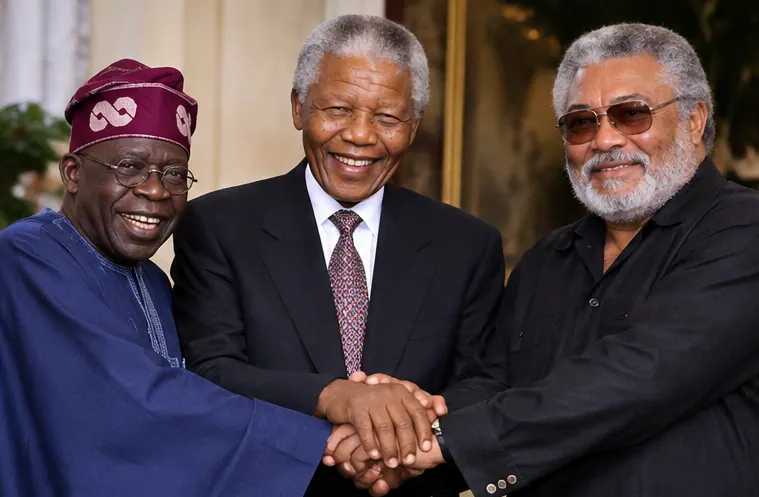
President Bola Ahmed Tinubu's political journey has sparked controversy and debate in Nigeria. To understand his legacy, it is essential to examine his career alongside other consequential African leaders, such as Nelson Mandela of South Africa and Jerry John Rawlings of Ghana. Their biographies demonstrate that political legacies are rarely defined by a single chapter. Tinubu's certificates may be questioned, and his biography may be contested, but his political accomplishments cannot be written out of history.
History has shown that consequential leaders do not require immaculate biographies. Mandela, for example, was once regarded as a dangerous opponent by the apartheid government. He helped establish the armed wing of the African National Congress and was convicted of sabotage before spending 27 years in prison. Those facts are not erased by his later achievements, but rather form part of the complicated story of his evolution from prisoner to negotiator and constitutional president.
Rawlings' political career in Ghana also presents an interesting example. His journey moved through military intervention, revolutionary government, and eventually, elected constitutional leadership. Historians and citizens may make different judgments about the stages of his career, but his story demonstrates that political identities are not necessarily frozen at the point of their greatest controversy. This broader historical context is relevant to Nigeria's continuing debate over President Tinubu.
There are legitimate questions surrounding aspects of President Tinubu's biography, and Nigerians have every right to ask them. However, legitimate scrutiny requires distinguishing among allegations, disputed claims, and established facts. During litigation in the United States in 2023, records from Chicago State University confirmed that Tinubu attended the institution and graduated in 1979.
The controversy surrounding Tinubu's education highlights the importance of distinguishing between an allegation and an established fact. The existence of a dispute over a document is not the same as establishing that a person's university attendance or graduation did not occur. Public officials should expect scrutiny, particularly over matters connected to their qualifications and public records. Criticism should remain within the bounds of what the evidence establishes.
President Tinubu's political career has produced a substantial body of evidence, including decisions, institutions, coalitions, reforms, electoral contests, administrative systems, and measurable outcomes. His rise involved decades of alliances, negotiations, political organisation, electoral contests, and institution-building. Whether one considers those activities positively or negatively, they are part of the historical evidence that must be examined when assessing his political career.
As President, Tinubu's record must be subjected to a demanding standard. His administration introduced major economic changes, including the removal of the petrol subsidy and reforms to Nigeria's foreign exchange regime. The International Monetary Fund has described reforms undertaken since 2023 as having strengthened macroeconomic stability, reduced fiscal vulnerabilities, rebuilt external buffers, and improved the functioning of the foreign exchange market. However, poverty and food insecurity remain significant challenges.
Key points
- President Tinubu's legacy will be evaluated based on his achievements and controversies.
- Historical context is essential in understanding the complexities of President Tinubu's political journey.
- Distinguishing between allegations and established facts is crucial in scrutinising public officials.