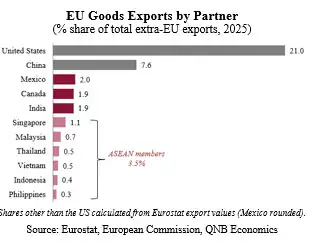
The European Union's external environment has significantly deteriorated over the past two years, with its two main trading partners, the US and China, becoming less reliable. The new EU-US framework agreement on reciprocal, fair, and balanced trade, which came into effect on July 1, 2026, sets a 15% tariff cap on most European exports, creating a higher trade barrier in the EU's primary export market.
The EU's trade deficit with China in goods reached €359.8 billion in 2025, with European exports declining by 6.5% and imports increasing by 6.4%. In response, the EU has embarked on an ambitious expansion of its commercial network, concluding agreements with Mercosur, Mexico, Indonesia, India, and Australia. These agreements will cover 53.3% of the EU's external trade with free trade agreements, up from 46.3% at the end of 2025.
The EU's new partnerships extend to Southeast Asia, with a substantial agreement on a free trade treaty with the Philippines in September, liberalizing over 94% of tariff lines. Negotiations with Thailand and Malaysia are also progressing, with the goal of finalizing the three agreements by 2027. These new partnerships, combined with existing agreements with Singapore, Vietnam, and Indonesia, would enable the EU to have a commercial network covering almost the entire Association of Southeast Asian Nations (ASEAN).
According to QNB Economics, the EU's commercial reorientation is a strategic response to a sustainable transformation of the global commercial environment. The benefits of this reorientation will materialize gradually as the new agreements come into effect. The three main objectives of this reorientation are to diversify trade beyond the EU's main commercial partners, access new sources of external demand and growth opportunities for a sluggish European economy, and strengthen economic security through more reliable access to critical raw materials.
The new agreements reduce the EU's exposure to its two main commercial partners, whose policies have become increasingly unpredictable. The US tariff hike has weighed on demand, with EU exports to the US plummeting by 30.4% year-over-year in the first quarter of 2026. Meanwhile, China has been redirecting its exports lost in the US market to Europe, increasing its trade surplus with the EU by 24% in the first four months of 2026.
The conclusion of a more extensive network of new commercial agreements can serve as a protection mechanism, diversifying external demand among a larger number of partners and reducing vulnerability to commercial policy changes or risks related to excessive concentration on a single market. Data indicate that this strategy is already producing results, with trade covered by free trade agreements growing by 3.1% in 2025, more than double the 1.4% growth recorded with other third countries.
The agreements also open up access to new sources of external demand, as European growth remains moderate and its industrial base remains under pressure. The agreement with India illustrates this potential, with tariffs on machines and chemicals to be largely eliminated. The agreement aims to double European goods exports to India by 2032, while allowing for an annual saving of around €4 billion in tariffs.
Key points
- The European Union has concluded several new commercial agreements to reduce its reliance on US and Chinese markets.
- The agreements aim to diversify trade, access new sources of external demand, and strengthen economic security.
- The EU's commercial reorientation is expected to produce benefits gradually as the new agreements come into effect.