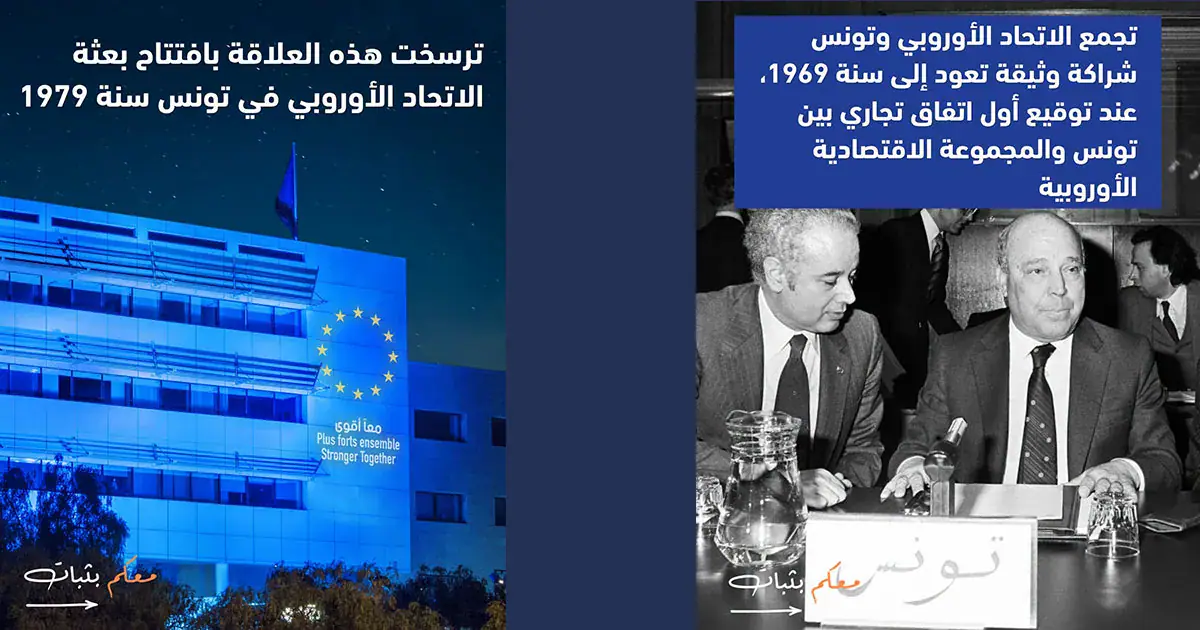
The European Union has reaffirmed its commitment to strengthening its partnership with Tunisia, with the EU delegation in the country launching a communication campaign highlighting the bilateral relations between the two. The campaign, which includes a message in Arabic on the EU delegation's official Facebook page, emphasizes the EU's desire to continue working with Tunisia towards stability, prosperity, and shared growth. This message comes at a time when voices in Tunisia are calling for a revision of the 1995 association agreement between Tunisia and the EU.
The association agreement, which was signed on May 17, 1995, has been perceived as unbalanced and favoring European strategic interests. In response to these concerns, the European Parliament hosted the fourth meeting of the EU-Tunisia Joint Parliamentary Commission on November 5, 2026. During the meeting, the two delegations adopted a joint declaration reaffirming their commitment to regular and constructive dialogue based on respect for sovereignty, trust, and mutual interests. They also reiterated their attachment to the common values enshrined in the association agreement, including democracy, the rule of law, and respect for fundamental rights.
The EU delegation in Tunisia has emphasized that its partnership with the country goes beyond agreements and projects, highlighting the importance of permanent dialogue, people-to-people exchanges, and cultural and economic ties between Tunisians and Europeans. The partnership has a long history, dating back to 1969 with the first commercial agreement between Tunisia and the European Economic Community. The EU-Tunisia partnership was further strengthened in 2012 when Tunisia was granted the status of privileged partner, and in 2023 with the signing of a memorandum on strategic and global partnership.
The EU has announced plans to support Tunisia's economic development through investments and concrete initiatives. The EU ambassador to Tunisia, Giuseppe Perrone, recently reaffirmed the EU's willingness to engage in constructive dialogue on the modernization of the 1995 association agreement. On the financial front, the EU has announced the signing of an agreement worth €80 million to support the Tunisian budget as part of a program promoting social inclusion. According to the European Commission, the EU's bilateral aid to Tunisia totals €770 million for the period 2021-2025.
One of the strategic projects between the EU and Tunisia is Elmed, a submarine electrical interconnection between Tunisia and Italy designed to promote energy exchanges and the development of renewable energies. The EU's communication campaign confirms its desire to value a partnership that goes beyond economic and energy issues, as well as migration cooperation, to strengthen the human dimension of Euro-Mediterranean relations through education, research, culture, and mobility.
Despite the EU's commitment to strengthening its partnership with Tunisia, concerns remain about the impact of this partnership on Tunisia's development. Critics argue that the cooperation in education and research currently benefits the EU more than Tunisia, as it continues to attract Tunisian medical professionals, engineers, and other skilled workers. Additionally, the EU's efforts to reduce migration flows from Tunisia have led to concerns about the treatment of migrants and the impact on Tunisia's economy.
The EU's partnership with Tunisia is part of a broader effort to strengthen relations between the EU and its Mediterranean partners. The EU has emphasized its commitment to supporting Tunisia's development and creating new opportunities for citizens on both sides of the Mediterranean. However, it remains to be seen whether the EU's words will be followed by concrete actions that benefit Tunisia and not just the EU.
Key points
- The EU has reaffirmed its commitment to strengthening its partnership with Tunisia through cooperation, investment, and concrete initiatives.
- The partnership between the EU and Tunisia has a long history, dating back to 1969.
- The EU has announced plans to support Tunisia's economic development through investments and concrete initiatives.