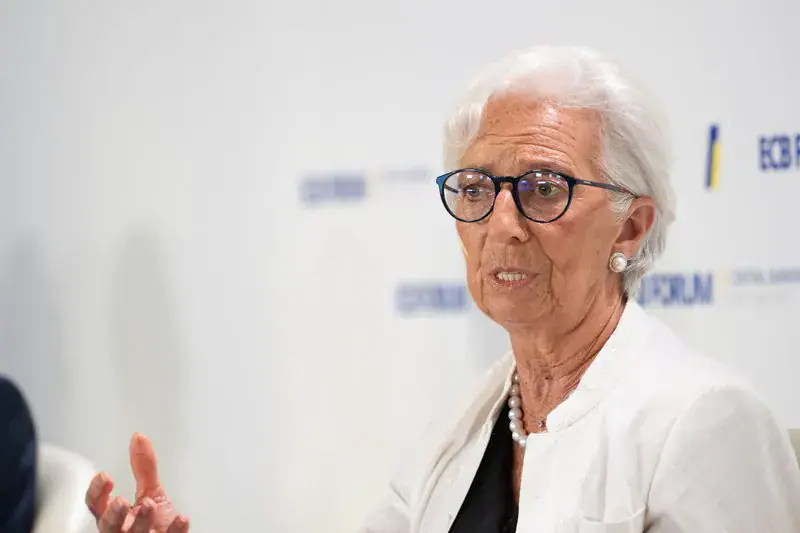
The European Central Bank (ECB) is facing a leadership transition as Christine Lagarde prepares to step down in February 2027. The ECB has confirmed that Klaas Knot, former head of the Dutch central bank, and Pablo Hernandez de Cos, former governor of the Bank of Spain, are the two official candidates to succeed her. Both candidates have extensive experience in central banking, with Knot serving from 2011 to 2025 and Hernandez de Cos from 2018 to 2024.
The selection process involves the 21 eurozone member states, which had until recently to submit their nominations. The ministers of finance from these countries will now review the candidates and are expected to recommend a name to their heads of state and government. This decision will be made after consultation with the European Parliament and the ECB's governing council. A final decision is anticipated by the end of the year, potentially at one of the upcoming European summits.
Klaas Knot, 59, and Pablo Hernandez de Cos, 55, have both built a reputation for their pragmatic approach to monetary policy. Knot led the Dutch central bank through significant economic challenges, while Hernandez de Cos has been instrumental in navigating the Spanish economy through turbulent times. Their ability to communicate effectively with financial markets and make decisive moves in times of crisis will be closely scrutinized.
The duel between Knot and Hernandez de Cos is also seen as a reflection of the broader north-south economic divide within the eurozone. Countries in the north, like the Netherlands, tend to favor stricter monetary policies to control inflation, while southern nations, such as Spain, often advocate for measures to support economic growth and employment. However, both candidates have demonstrated flexibility in their policy approaches.
The Spanish government has highlighted Hernandez de Cos's exceptional leadership skills, independence, and ability to engage in open dialogue. Meanwhile, supporters of Knot argue that it is time for a northern European country to take over the ECB presidency, a position that has been held by French and Italian officials since 2003. If the major countries cannot agree on a candidate, a surprise nominee could emerge, as was the case with Christine Lagarde's appointment in 2019.
The ECB is not only looking for a new president but also needs to fill two other key positions: chief economist and a member of the executive board. The current chief economist, Philip Lane, will step down in May 2027, and Isabel Schnabel, a German member of the executive board, is set to join the International Monetary Fund in early 2027. These vacancies could lead to further negotiations among European countries to secure these roles.
Lagarde's early announcement of her departure has also sparked speculation about the potential impact on the French presidential election and the distribution of key ECB roles. France might seek the chief economist position, though this has not been confirmed. The transition period will be closely watched, especially given the current tensions in the bond markets and high inflation rates.
Key points
- The European Central Bank is set to choose between Klaas Knot and Pablo Hernandez de Cos to succeed Christine Lagarde as president.
- The selection process involves review by eurozone finance ministers and consultation with the European Parliament and ECB governing council.
- A decision on the ECB presidency is expected by the end of the year, with implications for the distribution of other key roles at the bank.