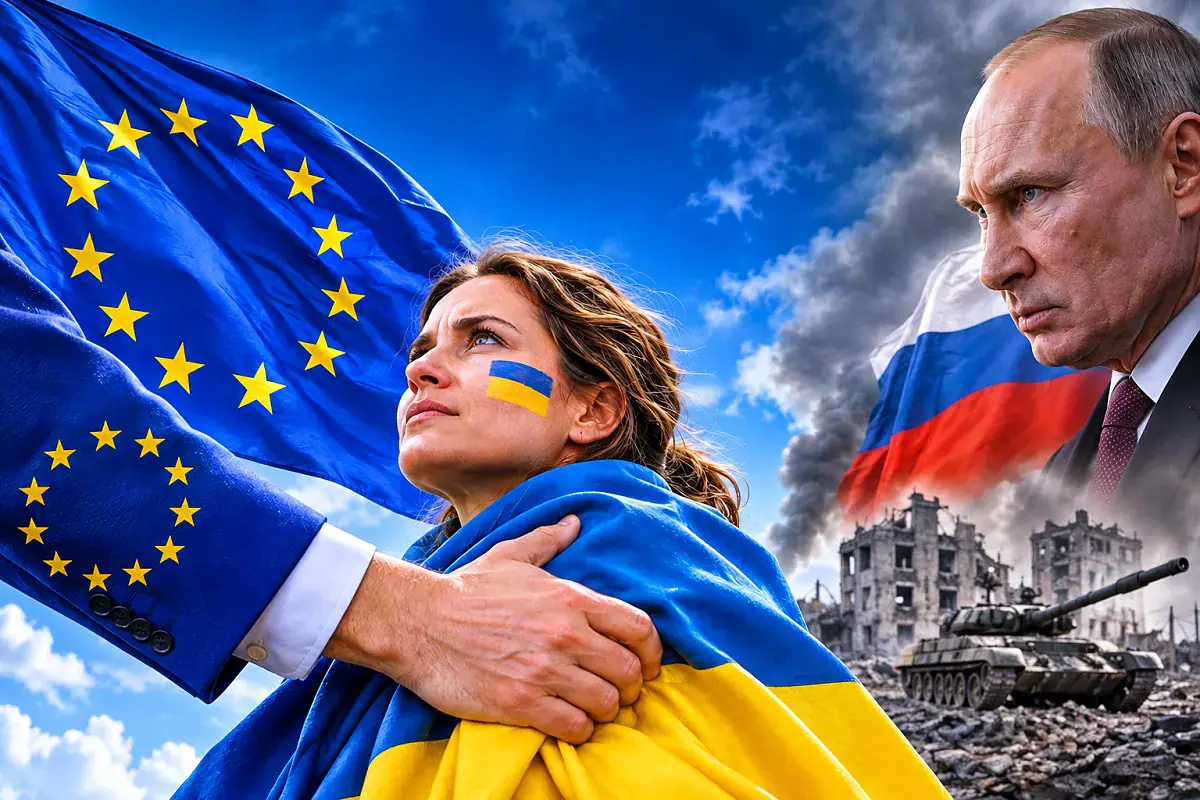
European support for Ukraine is motivated by a desire to defend the international order and the principle of state sovereignty, which is being challenged by Russia's invasion. According to Pascal Boniface, a French geopolitician and founder of the Institute for International and Strategic Relations, Europe's support for Ukraine is primarily driven by a need to protect these fundamental principles. The conflict has significant implications for the international order established after World War II.
Boniface emphasizes that Ukraine is fighting for its own sovereignty, not for Europe. He notes that Russia does not pose an immediate military threat to European countries, but is engaged in a hybrid war of destabilization, disinformation, and pressure. Europe must distinguish between solidarity with Ukraine and unconditional support, defining its own strategic objectives and setting limits on its engagement. This approach will help prevent a protracted war with unclear political prospects.
The analyst considers Vladimir Putin's conditions for a resolution to be largely unrealistic and unacceptable. These conditions include NATO's withdrawal to its 1997 borders and the removal of the Franco-British nuclear umbrella in Europe. However, certain issues could be subject to negotiation, such as potential territorial concessions, the presence of Western forces in Ukraine, and Ukraine's potential membership in NATO.
Ukraine's accession to NATO would require the unanimous approval of all member states, making it uncertain. Boniface advocates for a solution based on a ceasefire along the front line, without recognizing Russia's annexation of Ukrainian territories. He cites China's approach to the Crimea as a precedent, where Beijing does not acknowledge the annexation but maintains relations with Moscow.
Boniface's argument is informed by the Soviet Union's experience in Afghanistan, where internal opposition ultimately influenced the Soviet decision to withdraw. A similar dynamic could potentially play out in the Ukraine conflict. The international community is closely watching developments, with significant implications for global politics and security.
The conflict has sparked debate about the extent of European support for Ukraine. Some argue that a more substantial and direct aid package could help Ukraine regain control of its territories. However, others caution that such an approach risks escalating the conflict and having far-reaching consequences.
As the situation continues to unfold, European leaders face difficult decisions about how to balance their support for Ukraine with the need to avoid a wider conflict. The issue remains a pressing concern for policymakers and analysts, with significant implications for international relations and global stability.
Key points
- Europe's support for Ukraine is driven by a desire to defend international order and state sovereignty.
- The conflict has significant implications for the international order established after World War II.
- A solution based on a ceasefire along the front line, without recognition of Russia's annexation, may offer a way forward.
Reporting sources
- Pascal Boniface : les enjeux du soutien de l’Europe à l’Ukraine · L'Économiste maghrébin