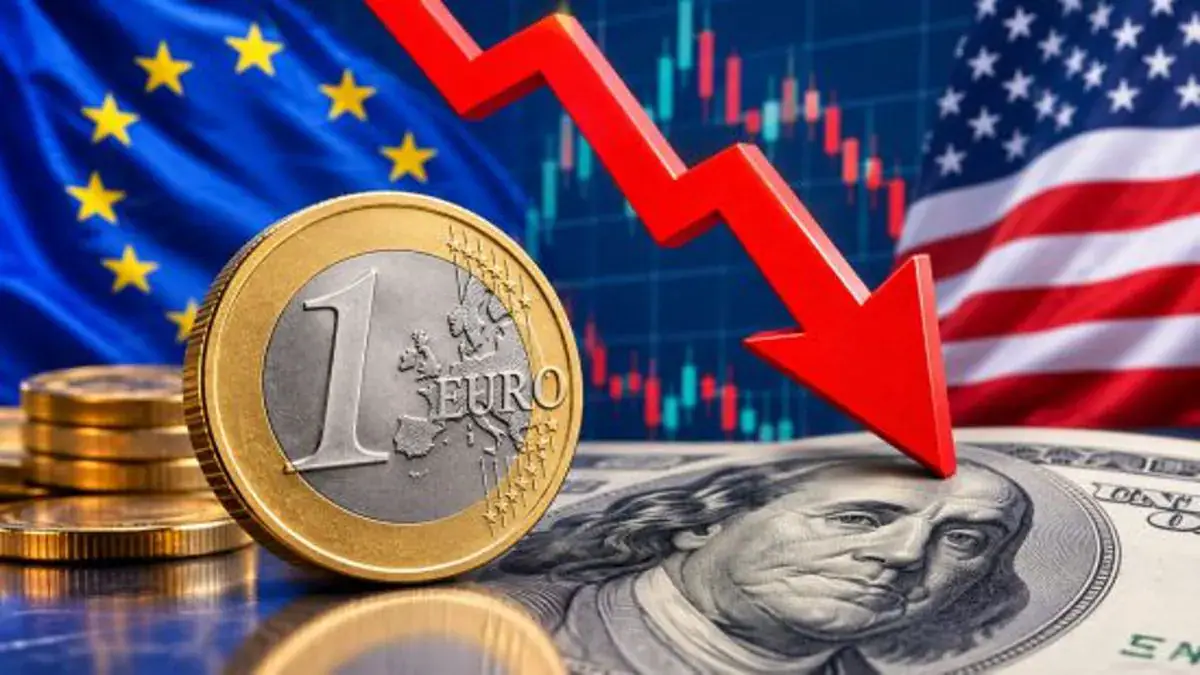
The euro declined sharply against the US dollar on Monday, November 23, 2026, reaching its lowest level since April 2025. The drop comes as the dollar strengthens and expectations rise for further US interest rate hikes to combat inflation. Weak economic indicators from France and divergent economic performance within the eurozone also contribute to the euro's decline. The euro's value against the dollar fell to around 1.0897, marking a daily loss of approximately 0.63%.
The US dollar's resurgence is a significant factor in the euro's decline. Investors are increasingly turning to the dollar, driven by expectations that the Federal Reserve will continue to tighten monetary policy to address inflation. Market estimates suggest a high probability of another 0.25% interest rate hike in December. These expectations were reinforced by statements from several Federal Reserve officials emphasizing the need to continue fighting inflation, making dollar-denominated assets more attractive compared to their European counterparts.
France's economic indicators have raised concerns among investors about the growth prospects in the eurozone. Preliminary data for November showed that France's composite purchasing managers' index (PMI) fell to 46.2 points, down from 46.6 points in October. This level, below the 50-point threshold that distinguishes between economic contraction and growth, reflects ongoing challenges in key sectors of France's economy, which is the second-largest in the eurozone.
In contrast, Germany's economic indicators appear more positive. The country's composite PMI rose to 55 points in November, its best performance in over four years, driven by an improvement in industrial activity. However, this positive development was not enough to offset France's weak performance or change the overall picture for the eurozone. The eurozone's composite PMI remained steady at 51.7 points, highlighting a growing gap between the region's two largest economies.
The European Central Bank (ECB) faces a challenging situation as the euro's decline may lead to higher import costs, particularly for energy and raw materials priced in dollars, potentially reigniting inflationary pressures in the European economy. Meanwhile, raising interest rates to address these pressures could increase borrowing costs for businesses and households, limiting investment and consumption in an economy that remains fragile in several EU countries.
Market participants are eagerly awaiting the ECB's interest rate decision in December, with expectations of another rate hike. However, investors are also monitoring the possibility of the ECB ending its monetary policy tightening cycle thereafter, which could impact the euro's ability to recover against the dollar. The dollar's strength and the euro's weakness reflect broader economic trends and policy expectations on both sides of the Atlantic.
The euro's decline to a 19-month low against the US dollar raises questions about whether this trend will persist. While the current drop does not necessarily indicate a structural collapse of the euro, it highlights the shifting balance of monetary power between the US and Europe. As investors navigate these dynamics, their attention will focus on upcoming economic data, including US inflation figures, to gauge the future trajectory of interest rates and the euro-dollar exchange rate.
Key points
- The euro fell to a 19-month low against the US dollar on Monday, November 23, 2026.
- Weak economic indicators from France and a strong US dollar contribute to the euro's decline.
- The European Central Bank faces a challenging situation in addressing inflationary pressures while avoiding harm to the economic growth.
Reporting sources
- اليورو ينهار أمام الدولار الأمريكي · Al-Massaa