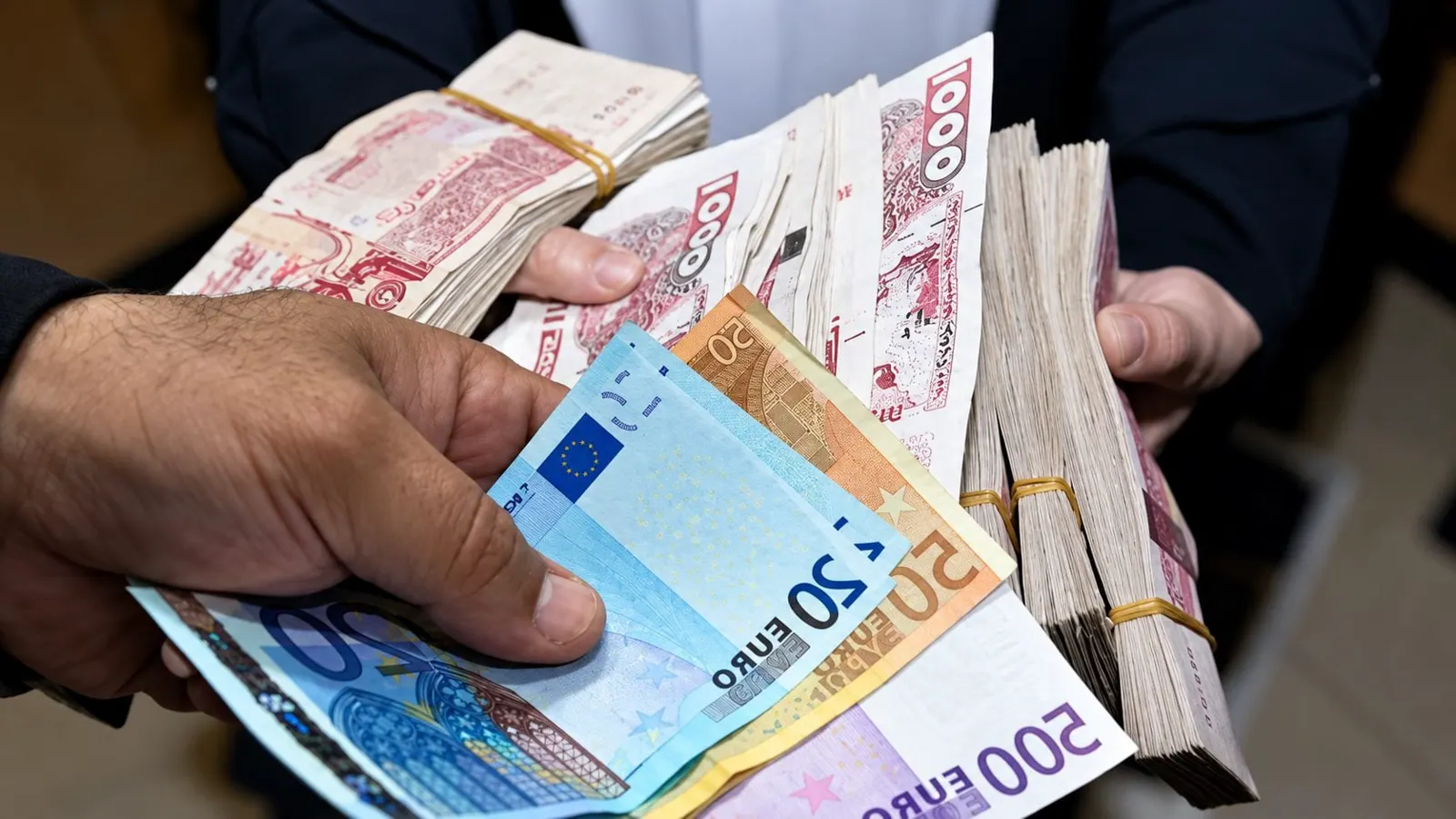
On Thursday, September 24, 2026, the euro's exchange rate on the parallel market in Algeria remained stable at 276 dinars for sale and 274 dinars for purchase. This stability has been observed for several days, with the euro lingering just below the 280-dinar mark, a trend seen since the beginning of 2026. In contrast, the dollar was trading at 238 dinars for sale and 236 dinars for purchase on the parallel market.
At the Banque d'Algérie, the official exchange rate for the euro has continued its downward trend, reaching 152.39 dinars for sale and 151.39 dinars for purchase. This represents a decline of nearly 2.5 dinars over the past month. The Banque d'Algérie's official rates are applicable to banking transactions, such as wire transfers and tourist allocations, but not to private currency exchanges.
The exchange rates for other currencies on the parallel market include the dollar at 238 dinars for sale and 236 dinars for purchase, the pound sterling at 314 dinars for sale and 311 dinars for purchase, and the Canadian dollar at 170 dinars for sale and 168 dinars for purchase. These rates can vary depending on the city, the amount exchanged, and the denominations.
On the official market, the Banque d'Algérie's exchange rates for other currencies include the dollar at 133.98 dinars, the pound sterling at 177.16 dinars, and the Canadian dollar at 94.93 dinars. These rates are used for official transactions, such as imports and exports.
The difference between the parallel and official markets remains significant, with the euro trading at 1.81 times its official rate, representing a premium of 81%. This disparity affects Algerians living abroad, who send remittances to their families. According to the International Fund for Agricultural Development (FIDA), remittances from the diaspora reached $1.79 billion in 2025.
The International Monetary Fund (IMF) has noted this disparity in its annual consultation, stating that greater flexibility in the exchange rate would help the Algerian economy absorb external shocks and reduce the premium on the parallel market. The IMF's comments highlight the need for economic reforms to address these issues.
When exchanging currencies, individuals should be aware that parallel market rates are indicative and can vary, while official rates change with each Banque d'Algérie quotation. It is essential to verify the current rates and regulations with banks or relevant authorities before conducting any transactions.
Key points
- The euro's exchange rate on the parallel market remains stable at 276 DA, while it declines to 152.39 DA at the Banque d'Algérie.
- The difference between the parallel and official markets remains significant, with a premium of 81% on the euro.
- The IMF has recommended greater flexibility in the exchange rate to help the Algerian economy absorb external shocks.