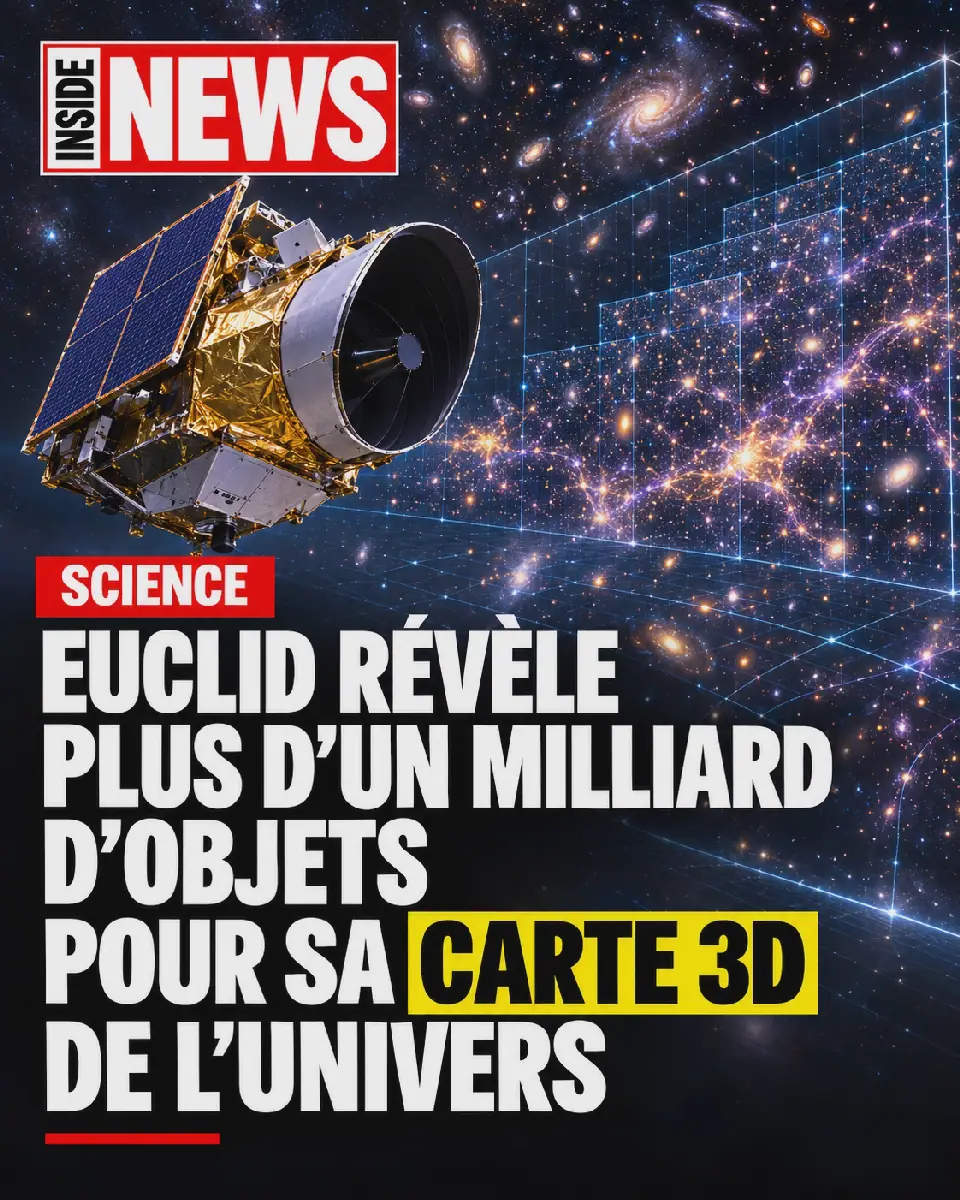
The European Space Agency's Euclid space telescope has released its first major data delivery, capturing the light of over 1 billion celestial objects. This dataset covers a portion of the sky equivalent to around 9,500 full moons and lays the groundwork for the most extensive 3D map of the cosmos. The ESA made the DR1-Foundation dataset public on November 12. The goal of Euclid is to study the large-scale structure of the universe and improve understanding of dark matter, dark energy, and cosmic evolution.
The released mosaic, known as the northern mosaic, approaches 500 gigapixels and comprises 740 observations conducted during autumn 2024 and spring 2025. It covers 367 square degrees of the sky, allowing researchers to transition from an overview to individual galaxies and stars. However, the number of objects does not represent 1 billion new discoveries; rather, it consists of recorded luminous sources intended for classification and analysis.
By measuring the shape, position, and distance of a vast number of galaxies, Euclid aims to reconstruct how matter has been distributed over time. Light distortions can indirectly reveal the presence of invisible matter. The 3D map is also expected to help researchers test how the universe's expansion has evolved. These analyses will require several years of processing, calibration, and comparison with other observatories.
The ESA presents this publication as a foundation, not the final result. The complete survey will cover a much larger area and accumulate sufficient observations to reduce statistical uncertainties. For both the public and researchers, the immediate interest lies in accessing an exceptionally large dataset. However, conclusions about the nature of dark energy or dark matter will come from scientific analyses, not just the volume of images.
The Euclid mission is designed to study the universe's large-scale structure and improve understanding of dark matter, dark energy, and cosmic evolution. Dark matter and dark energy are thought to make up around 95% of the universe, but their nature remains unknown. Euclid's 3D map will help scientists better comprehend these mysterious components.
The released dataset is a significant milestone for the Euclid mission, which began operations in 2024. The telescope is equipped with a powerful camera that allows it to capture high-resolution images of the sky. The data will be used to create a detailed 3D map of the universe, which will help scientists understand the universe's evolution and structure.
The ESA plans to continue processing and analyzing the data from Euclid, with future releases expected to provide even more insights into the universe. The mission is expected to continue for several years, providing scientists with a wealth of data to study the universe.
Key points
- The Euclid telescope has captured light from over 1 billion celestial objects, preparing for the largest 3D map of the cosmos.