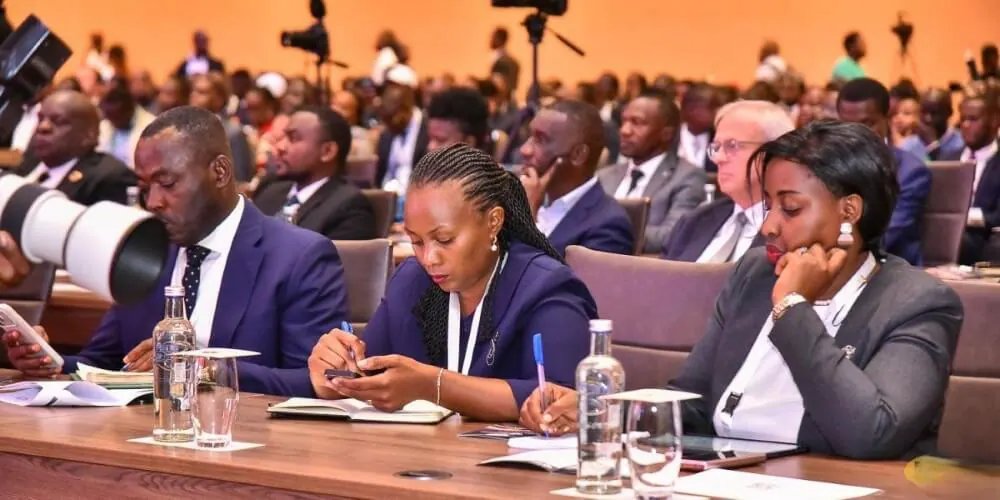
The European Union has pledged €25 million in grants to support Uganda's mining sector, with a focus on mineral value addition. EU Delegation Head in Uganda, Jan Sadek, announced the funding at the 15th Uganda Mineral Wealth Conference in Kampala. The conference, organised by the Uganda Chamber of Energy and Mines and the Ministry of Energy and Mineral Development, aimed to explore opportunities for Uganda to develop its mining sector. Sadek emphasized that the EU wants to work with Uganda to identify mineral value chains that can attract investment.
Sadek highlighted that Uganda's opportunity lies not in simply extracting minerals, but in building industries around their processing and utilization. He stressed that mineral extraction is not the main opportunity for Uganda, but rather ensuring that extracted minerals are processed, developed into skills, and create jobs. The EU wants to connect Ugandan companies and training institutions to European knowledge, technology, capital, and markets. This support aims to help Uganda move from exporting raw minerals to processing and beneficiation, a policy objective the government has pursued for over a decade.
The funding includes €6.25 million provided by the EU and Germany through GIZ for the Sustainable Development of the Mining Sector in Uganda. Sadek stated that across ongoing and planned engagements, the EU will have mobilized more than €25 million in grants to support Uganda's mining sector. This comes as Uganda seeks to attract more investment into mineral processing while retaining a greater share of the value generated from its mineral resources. The government has introduced measures to restrict the export of unprocessed minerals, including a special levy on unprocessed gold.
However, private investors have called for a phased and selective approach to restrictions on the export of unprocessed minerals, arguing that capacity needs to be developed without disrupting the mining industry. The Ministry of Energy and Mineral Development is pursuing reforms aimed at strengthening regulation of the mining industry. These reforms include the formation of the Uganda National Mining Company. State Minister for Energy Sidronius Okaasai Opolot stated that existing policies and laws do not adequately respond to the changing needs of the mining industry.
Opolot emphasized that the sector needs a standalone regulator, similar to regulatory arrangements in the electricity and oil and gas industries, as mining expands and attracts more local and international investors. He stressed that stronger regulation would improve investor confidence and help mobilize capital for processing and value addition. The proposed reforms aim to create a stable, transparent, and predictable regulatory environment supported by a clearly defined administrative structure.
Aggrey Ashaba, Chairman of the Governing Council of the Uganda Chamber of Energy and Minerals, called on Uganda's financial institutions to develop partnerships that can help reduce investment risks in mining and mobilize more capital for mineral value addition. Ashaba also emphasized that the country must move beyond extraction by strengthening processing, beneficiation, and national participation in the sector. The push for greater value addition is expected to require investment not only in processing facilities but also in laboratories, skills development, infrastructure, technology, and regulatory capacity.
The EU's support aims to help Uganda develop its mining sector and create jobs. The funding will be used to identify mineral value chains that can attract investment and develop a pipeline of investable projects. The EU wants to work with Uganda to export more finished mineral products to European markets. The support is expected to have a positive impact on Uganda's economy and help the country achieve its policy objectives in the mining sector.
Key points
- The EU has pledged €25 million in grants to support Uganda's mining sector, focusing on mineral value addition.
- The funding aims to help Uganda move from exporting raw minerals to processing and beneficiation.
- The EU wants to work with Uganda to identify mineral value chains that can attract investment and develop a pipeline of investable projects.