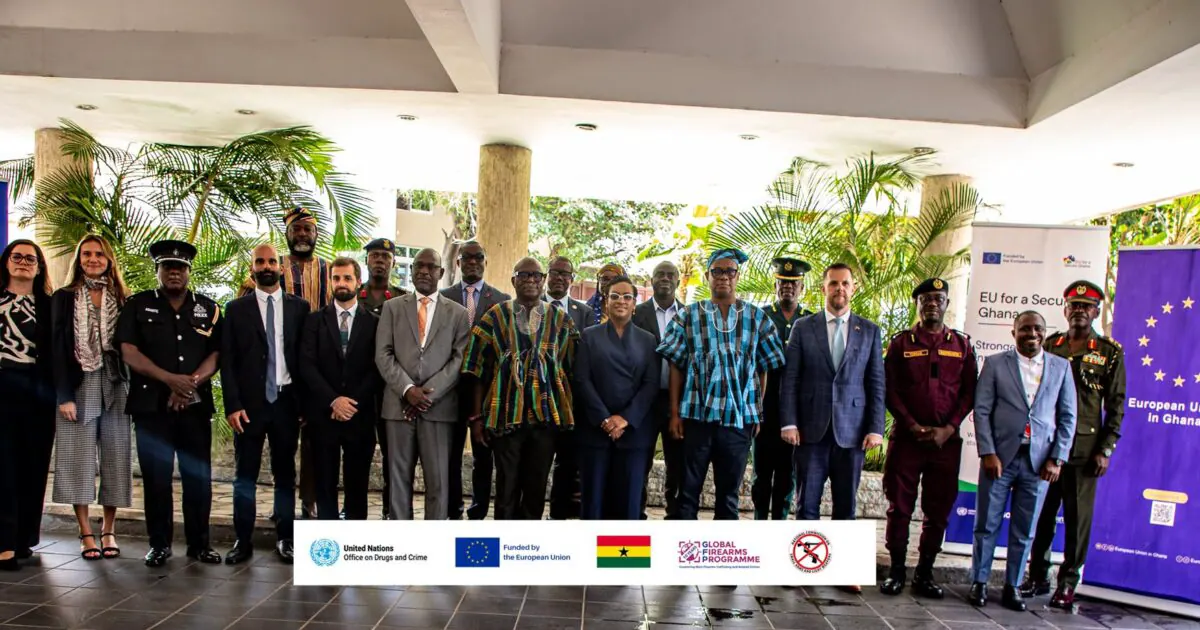
The Deputy Interior Minister, Ebenezer Okletey Terlabi, launched the project on 23rd September 2026, alongside the opening of a two-day national training workshop on the revised United Nations Illicit Arms Flows Questionnaire. The workshop was organised by the United Nations Office on Drugs and Crime in collaboration with the National Commission on Small Arms and Light Weapons (NACSA). The project aims to strengthen state institutions' ability to counter violent extremism and terrorism while upholding human rights and the rule of law.
The ‘EU for a Secure Ghana’ project will focus on strengthening state institutions' ability to counter violent extremism and terrorism. It will also support efforts to combat organised crime and arms trafficking and help communities, civil society organisations, and vulnerable groups contribute to conflict prevention. The project aligns with Ghana's security priorities and will be implemented with the support of the European Union and other development partners.
Deputy Interior Minister Ebenezer Okletey Terlabi commended the European Union and other development partners for their support for law enforcement, institutional accountability, community resilience, and firearms control. He stated that the project would help Ghana address its security challenges and improve its response to terrorism, organised crime, and arms trafficking.
NACSA Executive Secretary Dr Adam Bonaa noted that improved data collection and reporting would help strengthen Ghana's security response. He cautioned against taking the country's security for granted and emphasised the need for continued efforts to address security challenges. Dr Bonaa highlighted the importance of collaboration between stakeholders to ensure the success of the project.
The ‘EU for a Secure Ghana’ project is part of the European Union's efforts to support Ghana's security and stability. The project will be implemented over a period, and its impact will be monitored and evaluated to ensure that it achieves its objectives. The European Union has been working closely with Ghana to support its security priorities and address common challenges.
The launch of the project and the training workshop brought together stakeholders from various sectors, including government agencies, civil society organisations, and international partners. The stakeholders discussed the challenges and opportunities in addressing terrorism, organised crime, and arms trafficking in Ghana and the region. They also explored ways to strengthen collaboration and coordination to achieve better results.
The ‘EU for a Secure Ghana’ project is expected to contribute to Ghana's efforts to achieve sustainable peace and stability. The project will help to build the capacity of state institutions and civil society organisations to address security challenges and promote conflict prevention. The project's success will depend on the collaboration and commitment of all stakeholders involved.
Key points
- The European Union has launched the ‘EU for a Secure Ghana’ project to strengthen Ghana's response to terrorism, organised crime, and arms trafficking.