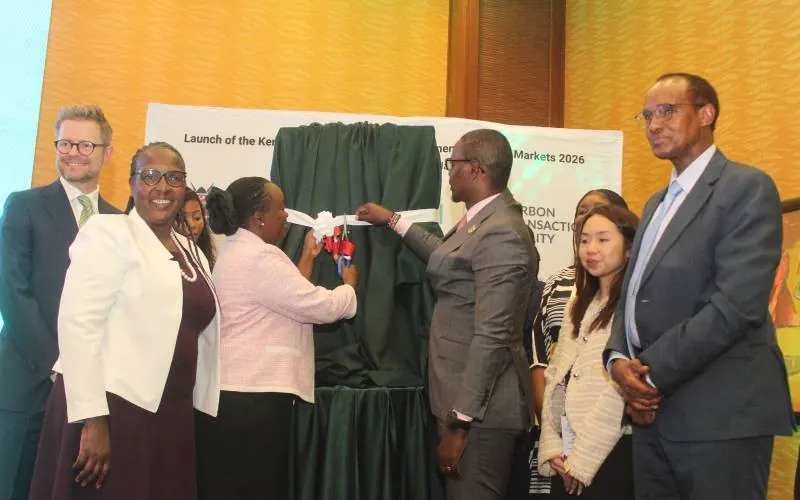
The European Union has committed Sh590 million to support Kenya in strengthening its carbon market. This funding will help the country enhance systems for monitoring, reporting, and validating climate action and carbon projects. The announcement was made during the launch of the Kenya Guide for Strategic Engagement in Carbon Markets 2026. The guide aims to provide a framework for Kenya's engagement with international carbon markets and help mobilize carbon finance.
EU Deputy Ambassador to Kenya Ondrej Simicek stated that the support is part of the EU's partnership with Kenya to develop a high-integrity carbon market. He emphasized that climate change does not respect borders and that Kenya and the EU are both experiencing its effects. Simicek mentioned that the EU had developed an integrated roadmap to guide Kenya's engagement in international carbon markets. This roadmap will enhance monitoring and validation systems through project reporting on both mitigation and national monitoring, reporting, and validation.
Environment and Climate Change Cabinet Secretary Deborah Barasa highlighted that financing is critical in mitigating the impact of climate change. She emphasized that carbon markets should not be viewed as an end in themselves but as a mechanism for mobilizing resources and creating development opportunities. Barasa noted that Kenya had put in place regulations and other measures to create a framework for carbon market development. The new guide will build on these efforts and provide greater clarity for investors while ensuring communities have a stronger basis for benefiting from carbon projects.
Barasa also emphasized that Kenya is open to responsible investment in carbon markets, but projects must meet strong environmental and social safeguards. She noted that the success of Kenya's carbon market will depend on collaboration between government, investors, communities, and other stakeholders. The credibility of Kenya's carbon market, Barasa said, will not be determined by what the country says but by what it does. Kenya will also need to strengthen its carbon accounting and monitoring systems to take advantage of opportunities presented by international carbon markets.
Nagnouma Kone, head of the Kenya Country Office and manager of Strategy and Partnerships at the Africa and Global Green Growth Institute (GGGI), stated that Kenya has significant opportunities in carbon markets but needs to move from potential to actual results. Kone emphasized that the new guidance should be implemented and operationalized to ensure the country translates its carbon market potential into tangible climate financing. Kenya's carbon market potential has not yet yielded tangible results, and the guidance is expected to change this.
The EU's support for Kenya's carbon market development is part of a broader partnership between the two entities to address climate change. Simicek mentioned that Europe is currently fighting wildfires, while Kenya is faced with the threats of El Nino, underscoring the need for countries to mobilize resources to respond to climate change impacts. The EU's commitment to supporting Kenya's climate action efforts is expected to have a positive impact on the country's ability to attract more climate financing.
The Kenya Guide for Strategic Engagement in Carbon Markets 2026 is expected to play a crucial role in Kenya's engagement with international carbon markets. The guide will provide a framework for Kenya's carbon market development and help ensure that carbon projects deliver benefits to local communities. With the EU's support, Kenya is poised to make significant strides in strengthening its carbon market and attracting more climate financing.
Key points
- The European Union has committed Sh590 million to support Kenya in strengthening its carbon market.
- The funding will help Kenya enhance systems for monitoring, reporting, and validating climate action and carbon projects.
- The success of Kenya's carbon market will depend on collaboration between government, investors, communities, and other stakeholders.