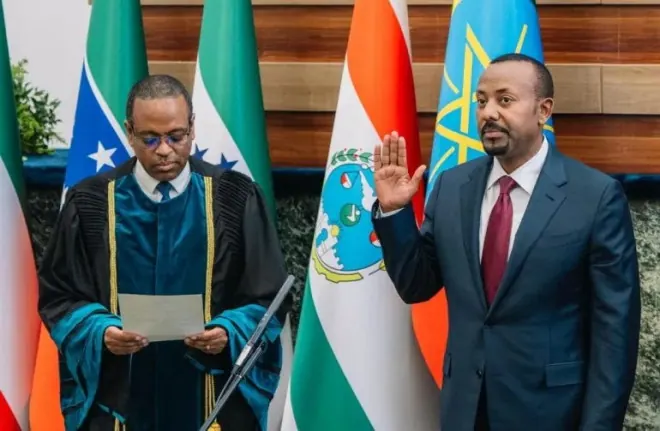
Ethiopian Prime Minister Abiy Ahmed has reiterated his country's need for access to the Red Sea, a demand that has strained relations with neighbouring countries. During his swearing-in ceremony for a new five-year term, Abiy emphasized the importance of securing a port on the Red Sea, citing its critical role in Ethiopia's "civilisation". He stressed that the country would work diligently to ensure access to the sea, based on the principle of give and take.
Abiy's call for Red Sea access comes as Ethiopia's relations with its neighbours have worsened in recent months. The country has accused Eritrea, Egypt, and Sudan of supporting opposition forces in Tigray, following a resurgence of fighting against Abiy's government in the northern region. Eritrea, in turn, has accused Ethiopia of seeking access to the sea through its territory. These tensions have raised concerns about regional stability.
A separate dispute over Ethiopia's Grand Ethiopian Renaissance Dam on the Nile River has strained relations with Egypt and Sudan, which rely on the river for water. The dam has been a point of contention between the three countries, with Egypt and Sudan expressing concerns about the impact on their water security. Ethiopia, however, maintains that the dam is essential for its economic development.
Four of the five countries bordering the Red Sea – Egypt, Eritrea, Sudan, and Somalia – met in Egypt's New Alamein and called for cooperation on regional issues. They emphasized that governance of the Red Sea was the exclusive responsibility of its coastal states and rejected actions that could affect Egypt and Sudan's use of Nile waters. The meeting highlighted the complexities of regional politics and the need for cooperation.
In response to the meeting, Ethiopia's Foreign Ministry stated that discussions over the Red Sea must account for the country's "legitimate interests and enduring connection" to the body of water. This statement underscores Ethiopia's determination to secure access to the Red Sea, despite opposition from its neighbours. The issue remains a major challenge for regional diplomacy.
Somalia's President, Hassan Sheikh Mohamud, who attended the Egypt summit, congratulated Abiy on his re-election and expressed his willingness to work closely with him to strengthen Somalia-Ethiopia relations. Mohamud had previously stated that Somalia did not object to Ethiopia gaining access to the Red Sea through Somali territory, but added that the two countries would need to officially negotiate. His comments suggest a potential avenue for diplomatic engagement.
The international community has taken note of Abiy's re-election, with several leaders sending messages of congratulations. Burundi's President, Evariste Ndayishimiye, and Mahmoud Ali Youssouf, the chairperson of the African Union Commission, both wished Abiy "every success during his renewed mandate". These messages reflect the importance of Ethiopia's leadership in regional affairs and the need for cooperation to address common challenges.
Key points
- Ethiopia's Prime Minister Abiy Ahmed has insisted on securing access to the Red Sea, sparking tensions with neighbouring countries.
- The dispute over Ethiopia's Grand Ethiopian Renaissance Dam has strained relations with Egypt and Sudan.
- Somalia's President Hassan Sheikh Mohamud has expressed willingness to negotiate with Ethiopia over Red Sea access.