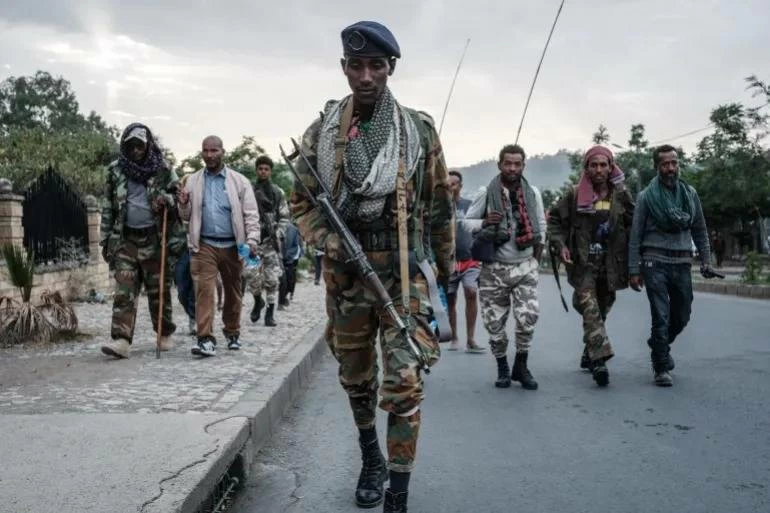
A significant development has emerged in the ongoing conflict in Ethiopia, where a coalition of 7 armed groups has united to challenge the government led by Prime Minister Abiy Ahmed. The coalition, announced by Emmanuel Assefa, deputy head of the Tigray People's Liberation Front (TPLF), aims to overthrow the federal government and establish a transitional administration. This move comes amid escalating clashes between the TPLF and government forces.
The coalition comprises various armed groups representing different ethnic and regional groups across Ethiopia. These include the TPLF, which operates in the northern region of Tigray, the Fano militia in the Amhara region, the Oromo Liberation Army in the Oromia region, and armed groups from the Somali state, Afar region, Ogaden region, and the Shenegul-Qamzat region. The formation of this coalition highlights the diverse opposition to the Abiy Ahmed government.
The TPLF, a key component of the coalition, has a long history of opposing the Ethiopian government. Founded in 1975, the TPLF led a rebellion against the regime of Mengistu Haile Mariam, contributing to his overthrow in 1991. The TPLF presented itself as a political movement defending the rights and interests of the Tigray people, advocating for a federal system that recognizes the rights of Ethiopian nationalities. However, its relations with the federal government deteriorated after Abiy Ahmed became prime minister in 2018.
The conflict between the TPLF and the federal government turned violent in November 2020, leading to a two-year war that ended with the Pretoria Peace Agreement in November 2022. However, clashes resumed earlier this month, drawing attention to the opposition groups' determination to challenge the government. The TPLF's shift from a governing party to an opposition force has significantly impacted the country's political landscape.
Another crucial component of the coalition is the Fano militia, which emerged as a major armed group in the Amhara region. In August 2026, one of Fano's prominent field commanders, Zemene Kassa, announced that the militia's factions had begun operating under unified leadership. This development aims to consolidate the various armed groups within the Amhara region under a single command structure.
The formation of this coalition and the resumption of clashes between the TPLF and government forces have significant implications for Ethiopia's stability and security. The opposition groups' united stance against the Abiy Ahmed government underscores the growing resistance to his leadership. The situation remains volatile, with the potential for further escalation and its consequences for the region and the country as a whole.
The international community is closely monitoring the developments in Ethiopia, given the country's strategic importance in the Horn of Africa. The conflict has already had humanitarian implications, with thousands displaced and reports of casualties. Efforts to mediate a peaceful resolution to the conflict are ongoing, but the opposition groups' united stance presents a significant challenge to the Abiy Ahmed government's authority.
Key points
- A coalition of 7 armed groups has formed to overthrow the Ethiopian government led by Prime Minister Abiy Ahmed.
- The Tigray People's Liberation Front (TPLF) and the Fano militia are key components of the coalition.
- The conflict has significant implications for Ethiopia's stability, security, and humanitarian situation.