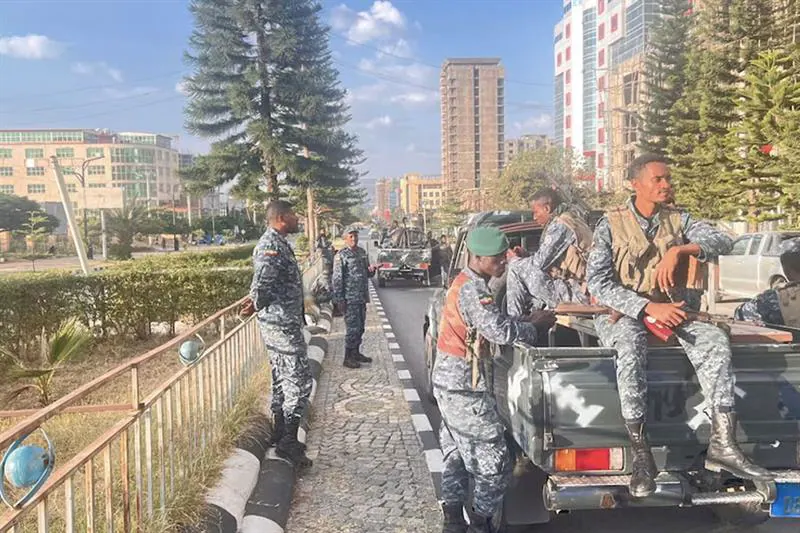
Ethiopia has informed the UN Security Council that it is taking measures in self-defence against Eritrea, accusing its neighbour of sending troops across the border and occupying parts of northern Ethiopia. In a letter dated Friday, Foreign Minister Gedion Timothewos invoked Ethiopia’s right to self-defence under Article 51 of the U.N. Charter. The letter accused Eritrea of deploying infantry and mechanised units in recent weeks and supporting, financing, arming and directing insurgent groups.
The accusations deepen a rift between countries whose armies fought together against the Tigray People’s Liberation Front from 2020 to 2022. Researchers at Ghent University in Belgium estimated the previous war caused about 500,000 civilian deaths in Tigray from violence, famine and the collapse of health services. Eritrean Information Minister Yemane Gebremeskel accused Ethiopia on Friday of pursuing aggression against Eritrea through its demands for sovereign access to the Red Sea.
Ethiopian Prime Minister Abiy Ahmed reiterated Monday that Ethiopia must have access to the Red Sea. Ethiopia’s Foreign Ministry said it remained committed to dialogue with its neighbours. Eritrea announced last week it was severing diplomatic ties after Ethiopia expelled 10 Eritrean diplomats and closed its embassy in Asmara. The move comes amid escalating tensions between the two nations.
Government-allied forces report gains in Tigray, with commander Ermiyas Ababu stating that they took Idaga Hamus early Friday and Abiy-Adi, in the Tembien area, on Thursday afternoon. Residents also reported the takeover of Idaga Hamus. Gebremedhin Kihishen, a business owner in Tembien, said government-allied forces controlled Abiy-Adi. The Armed Conflict Location & Event Data monitoring group, known as ACLED, separately reported Eritrean troops crossing at Zelambesa on Wednesday and coming under drone attack while travelling toward Idaga Hamus.
The TPLF joined six other opposition groups last month in an alliance seeking to oust Abiy. Fighting escalated late in September, undermining the 2022 peace agreement, and rebels seized Tigray's capital Mekelle and its airport. The rebels announced their withdrawal Oct. 3, and government-allied fighters entered the city. Mekelle awaits a new administration, with federal police calling over loudspeakers for residents to help establish a new administration.
In Mekelle, government offices remained shut, and no administration had taken office by Friday morning. The Tigray Peace Force imposed an overnight curfew Wednesday. The U.S. Embassy said Thursday that telecommunications had resumed in Mekelle and much of Tigray, while mobile banking and electricity had partially resumed. All remained subject to interruption. During the previous war, the AP documented accounts accusing Eritrean soldiers of killings, rape and looting.
Eritrean President Isaias Afwerki dismissed allegations of abuses by his forces as “a fantasy” in 2023. The situation in Tigray remains volatile, with concerns of a widening war. The international community is closely monitoring the developments, and efforts to establish a new administration in Mekelle are underway.
Key points
- Ethiopia accuses Eritrea of sending troops across the border and occupying parts of northern Ethiopia.
- The accusations deepen a rift between countries whose armies fought together against the Tigray People’s Liberation Front from 2020 to 2022.
- Government-allied forces report gains in Tigray, with commander Ermiyas Ababu stating that they took Idaga Hamus early Friday and Abiy-Adi, in the Tembien area, on Thursday afternoon.