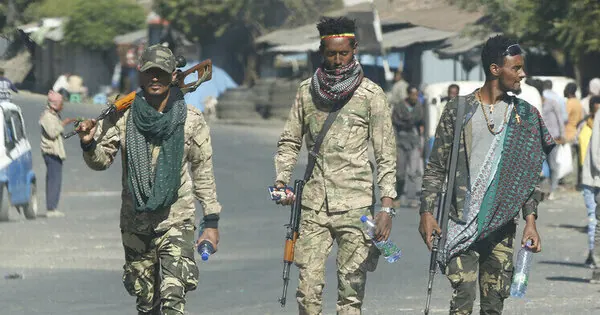
Escalating clashes between Ethiopian troops and Tigrayan forces have raised fears of a return to full-scale war in the north of the country. The federal army reported killing 272 regional fighters and wounding 260 others in a counteroffensive. The fighting prompted the suspension of flights to the holy town of Lalibela, home to UNESCO-listed rock-hewn churches. Northeast army commander Lieutenant General Assefa Chekol stated that the army is conducting targeted counter-attacks to clear the occupied zone of the enemy.
The conflict began with conflicting accounts from both sides. An adviser to Prime Minister Abiy Ahmed accused the Tigray People's Liberation Front (TPLF) of launching an "all-out offensive" against government positions in Amhara and Afar. However, Tigray's regional authorities claimed their troops entered a "defensive battle" after federal forces attacked them with aircraft, drones, and artillery. TPLF Vice President Amanuel Assefa described the situation as "full-blown war."
The TPLF dominated Ethiopian politics for nearly three decades before Prime Minister Abiy Ahmed took office in 2018. A power struggle between his government and Tigray's leaders erupted into war in November 2020. The conflict resulted in hundreds of thousands of deaths before an African Union-mediated peace agreement was signed in 2022. However, disputes over territory, the return of displaced people, and the disarmament of Tigrayan forces remain unresolved.
The latest escalation follows the announcement of an alliance between the TPLF and six other groups, including its former Amhara adversaries, seeking to remove Abiy's government. The African Union has condemned the violence, warning that the formation of new political and military alliances risks further destabilizing the region. The AU has asked its mediator, former Nigerian President Olusegun Obasanjo, to reengage with the parties.
The conflict has resulted in the seizure of airports in Mekelle, Axum, and Shire by TPLF-linked forces. Ethiopian Airlines halted flights to these cities in Tigray. The UN has called for civilian protection and humanitarian access. The situation remains volatile, with concerns over the potential for widespread violence and humanitarian crises.
In May, the TPLF restored Tigray's prewar regional council and elected party leader Debretsion Gebremichael as president following a dispute over the region's leadership. The development has contributed to the current tensions. The international community remains concerned about the situation, with the US and other countries urging restraint and dialogue.
The Ethiopian government and the international community face pressure to find a peaceful resolution to the conflict. The African Union's mediation efforts aim to revive the stalled peace process. However, the situation remains uncertain, with the risk of further escalation and violence.
Key points
- The Ethiopian federal army reported killing 272 regional fighters and wounding 260 others in a counteroffensive against Tigrayan forces.
- The conflict has resulted in the suspension of flights to the holy town of Lalibela and the seizure of airports in Mekelle, Axum, and Shire.
- The African Union has condemned the violence, warning that the formation of new political and military alliances risks further destabilizing the region.