The Horn of Africa and the Red Sea region are home to numerous foreign military bases, strategic alliances, and security arrangements. Djibouti hosts a large concentration of foreign military bases, including those of the US, China, France, Japan, and Italy. Somalia hosts military bases operated by the US, Turkey, and the UAE, while Eritrea has intelligence and electronic surveillance facilities maintained by Israel. Russia also has security agreements with Eritrea for the use of facilities at the Port of Massawa.
The region has various military and security alliances aimed at promoting stability and combating threats. The African Union and the UN provide a framework for supporting the Somali government and fighting Al-Shabaab, involving forces from countries such as Uganda, Burundi, Kenya, Djibouti, and Ethiopia. The Council of Arab and African States Bordering the Red Sea and the Gulf of Aden was established to strengthen cooperation and security among member states, including Saudi Arabia, Egypt, Jordan, Sudan, Djibouti, Somalia, and Eritrea.
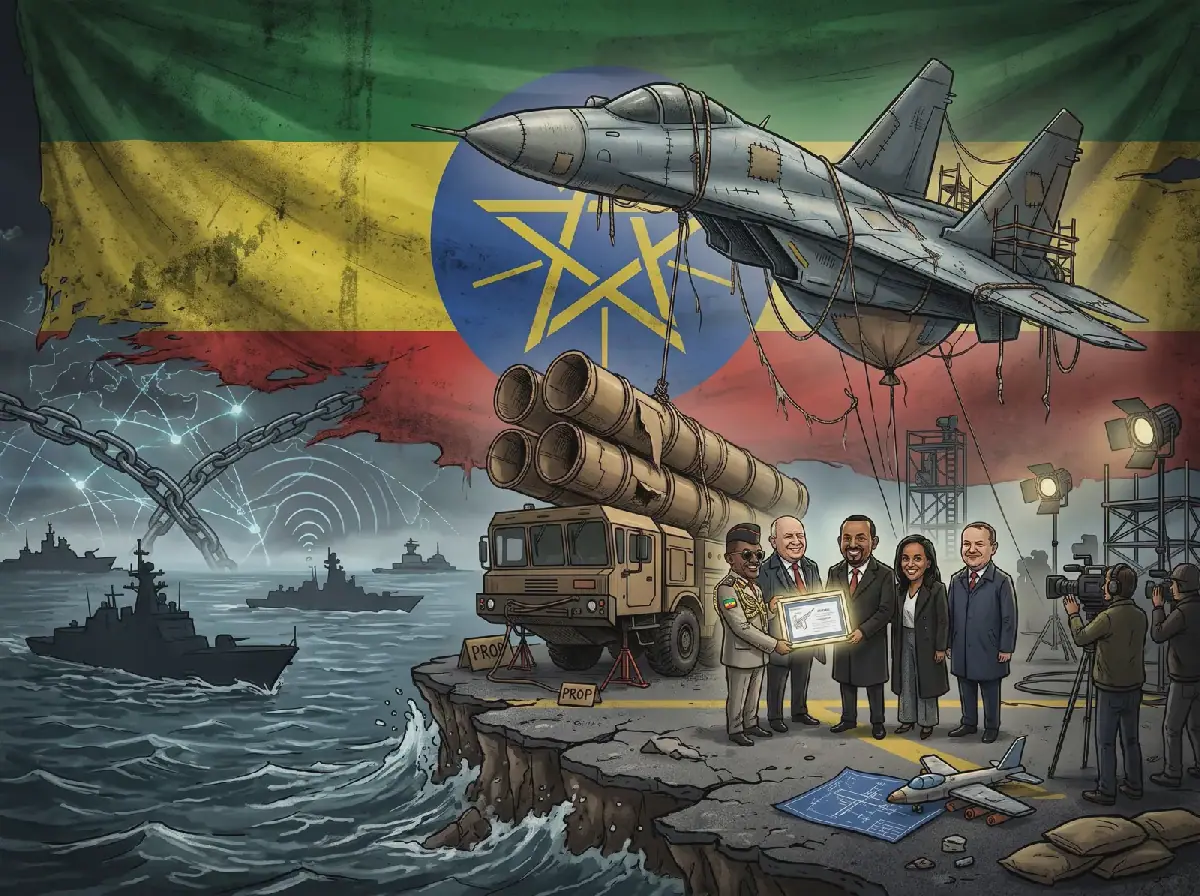
Some argue that Ethiopia's acquisition of 12 Su-35 fighter jets and four S-400 air defence batteries could alter the balance of power in the region. However, experts say that the effectiveness of these systems depends on various factors, including the ability to deploy and operate them successfully. The distance between Egyptian military airbases and the Grand Ethiopian Renaissance Dam exceeds 1,500 to 2,000 kilometres, which could limit Egypt's ability to launch a strike.
Egypt's Air Force operates advanced fighter aircraft, including Rafale, MiG-29, and F-16, supported by aerial refuelling tankers and long-range air-to-ground weapons. These capabilities allow for the launch of missiles from safe stand-off distances, beyond the direct engagement range of air defence systems. The S-400 system, while capable, requires integration with a layered early-warning radar network and comprehensive air defence architecture.
The Egyptian military has decades of experience in developing integrated air defence networks, conducting complex air operations, and employing electronic jamming and electronic warfare capabilities. This experience constitutes a decisive advantage in any tactical or strategic confrontation. A carefully planned aerial operation would employ aerial deception, electronic warfare, and intensive jamming to reduce the effectiveness of Ethiopian fighter aircraft.
According to a report, the Su-35E fighters acquired by Ethiopia were originally manufactured for Egypt, but Cairo cancelled the deal after redirecting its procurement strategy towards more advanced Rafale fighters. Moscow concluded the agreement with Addis Ababa to avoid disrupting production lines allocated to its own armed forces amid the war in Ukraine.
In conclusion, experts believe that Ethiopia's military acquisition is unlikely to fundamentally alter the balance of power in the Horn of Africa or curtail Egypt's regional role. The concentration of foreign military bases, overlapping strategic interests, and complexity of the regional landscape make it unlikely that 12 fighter jets and four S-400 air defence batteries could single-handedly turn the strategic equation upside down.
Key points
- Ethiopia's acquisition of 12 Su-35 fighter jets and four S-400 air defence batteries may not significantly alter the balance of power in the Horn of Africa.
- The region has various military and security alliances aimed at promoting stability and combating threats.
- Egypt's military experience and capabilities constitute a decisive advantage in any tactical or strategic confrontation.