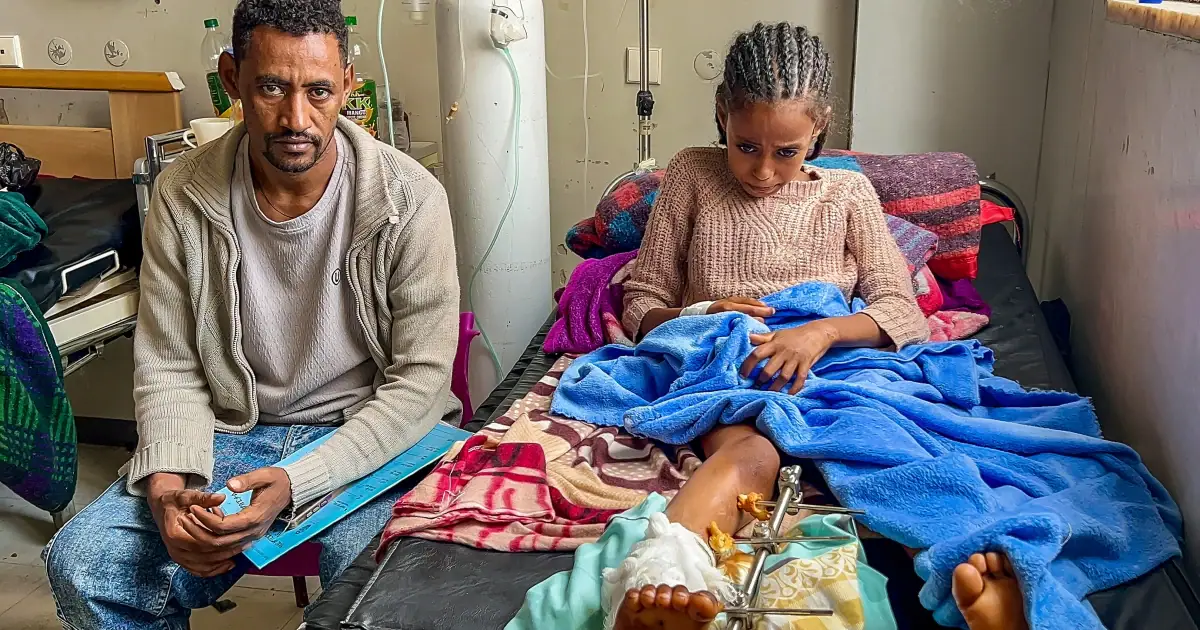
The healthcare system in Ethiopia's northern Tigray region is struggling to cope with the ongoing conflict between the Ethiopian government and rebel groups. A surgeon in Mekele, the capital city of Tigray, described the situation as "chaos" and "a mess" that lasted for almost seven days. The surgeon, who asked not to be named, recalled treating as many patients as possible at a hospital in Mekele, but with limited resources and no access to cell networks or electricity.
The conflict in Tigray has been ongoing for several weeks, with concerns that Ethiopia could again face a civil war. The Ethiopian military has accused Sudan, Egypt, and Eritrea of backing Tigrayan militants, who have aligned themselves with seven rebel groups in Ethiopia with the goal of ousting Prime Minister Abiy Ahmed. The World Health Organization (WHO) has expressed concern that the violence is pushing an already fragile health system closer to collapse.
The director-general of WHO, Tedros Adhanom Ghebreyesus, posted on social media that hospitals in Tigray are facing shortages of workers, medicine, and ambulances. Tedros, who is Tigrayan and previously served as Ethiopia's minister of health, said that WHO and the UN are working to deliver medical supplies to the affected regions. He emphasized that civilians must be protected and that the most courageous choose peace.
Public health experts say that targeted attacks on healthcare have become a growing concern in conflict zones around the world. According to WHO data, attacks on healthcare facilities and workers in 19 countries have led to more than 960 deaths so far in 2026. The largest mass casualty event occurred in a Pakistani airstrike on a drug rehabilitation center in Afghanistan, while hundreds of people have died in attacks on healthcare settings in Sudan, Lebanon, and Ukraine.
Funding cuts to global health initiatives, including the dismantling of USAID, have complicated matters. Lindsey Green, a researcher focused on Ethiopia for the US nonprofit Physicians for Human Rights, says that the continual attack against healthcare is eroding the norm of healthcare being a protected part of conflict. Green notes that the Tigray war lasted two years, killing an estimated 600,000 people, and that the majority of Tigray's health facilities were only partially functional.
A report by Physicians for Human Rights and the Organization for Justice and Accountability in the Horn of Africa detailed attacks on healthcare workers and facilities in northern Ethiopia. Of more than 600 health workers surveyed, 63% reported attacks on ambulances, and 57% reported witnessing an armed takeover of their clinic or hospital between 2020 and 2024. One health worker in Mekele recalled Ethiopian forces occupying a hospital and forcing staff to step on uniforms of Tigrayan rebels.
Doctors in northern Ethiopia say that the ongoing conflict and funding cuts have left the region without a chance to recover. A health worker in Tigray counted more than 100 women who died in childbirth over the past year, attributing their deaths to the dire state of the health system. An independent review of birth data during the Tigray war showed that the maternal mortality rate per 100,000 live births increased fivefold compared to prewar data.
Key points
- The Ethiopian healthcare system is struggling to cope with the ongoing conflict and funding cuts.
- Targeted attacks on healthcare have become a growing concern in conflict zones around the world.
- The conflict in Tigray has resulted in significant human suffering, with an estimated 600,000 people killed and many more affected.