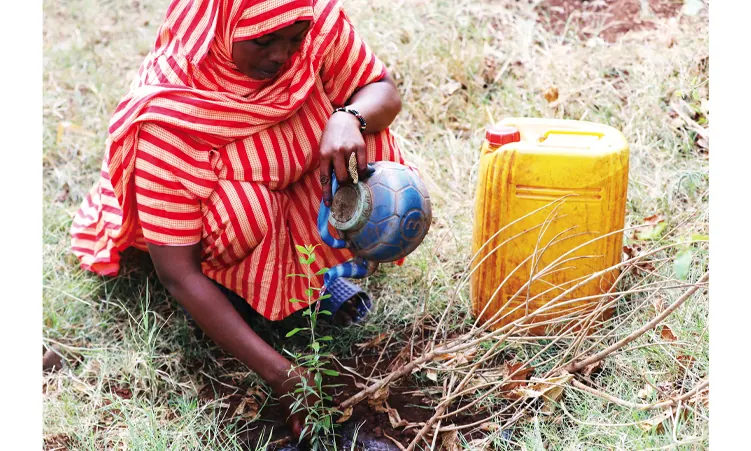
Halima Kedir, a 35-year-old resident of Ethiopia's Oromia region, has become an unlikely environmentalist, inspiring others to plant trees in her community. Despite initial skepticism from her neighbors, Kedir's dedication to planting thousands of trees has earned their respect and admiration. Her garden, now lush with banana, olive, and grevillea trees, has become a testament to the power of perseverance and the importance of trees in addressing climate change and food insecurity.
Ethiopia has a history of large-scale deforestation, with 560,000 hectares of tree cover lost between 2000 and 2025 due to agricultural expansion, commercial logging, and charcoal use. This has had devastating impacts on biodiversity, soil quality, and water resources, increasing the risk of climate-related disasters. However, the Ethiopian government's Green Legacy Initiative (GLI), launched in 2019, has helped slow the rate of deforestation, which fell from 92,000 hectares to 27,703 hectares annually between 2013 and 2023.
The GLI has been instrumental in increasing forest cover in Ethiopia, which has risen from 15.5% to 23.6% between 2013 and 2023. The government claims to have planted 48 billion trees in seven years, including a record-breaking 353 million seedlings in one day. The goal is to plant 50 billion trees by 2030, a target that Kedir and her community are working towards. Kedir's neighbor, Fate Abdulahi, has joined in, inspired by her success and commitment to finding local solutions to environmental issues.
Kedir's approach to tree-planting is deeply rooted in her Oromo culture, which values community and adoption. She describes her relationship with the seedlings in maternal terms, saying, "Just like we adopt a child in our tradition, I see them like my own children." This approach has helped her care for her trees diligently, even in the face of severe water shortages. Her son, Anwar Hassen, 13, hopes to follow in her footsteps, making a lifelong commitment to fighting climate change.
Thousands of households in nearby kebeles have also joined Kedir in planting trees, inspired by her success and the government's initiatives. The GLI has not only helped to slow deforestation but also raised awareness about the importance of trees in addressing climate change and food insecurity. As Ethiopia continues to face environmental challenges, the success of the GLI and initiatives like Kedir's offer hope for a more sustainable future.
The impact of the GLI extends beyond environmental benefits, as it has also helped to change attitudes towards tree-planting and environmental conservation. Kedir's story is a testament to the power of individual action and community involvement in addressing environmental challenges. As the government continues to work towards its goal of 50 billion trees by 2030, it is likely that initiatives like the GLI will play a critical role in shaping Ethiopia's environmental future.
The success of the GLI and Kedir's tree-planting efforts serve as a model for other communities in Ethiopia and beyond. As the country continues to face environmental challenges, the importance of initiatives like the GLI and individual actions like Kedir's cannot be overstated. With continued commitment and effort, it is possible that Ethiopia can achieve its goal of 50 billion trees by 2030 and make a significant contribution to global efforts to combat climate change.
Key points
- Ethiopia's Green Legacy Initiative has planted 48 billion trees in seven years, with a goal of 50 billion by 2030.
- The initiative has helped slow deforestation, with the annual rate falling from 92,000 hectares to 27,703 hectares between 2013 and 2023.
- Forest cover in Ethiopia has increased from 15.5% to 23.6% between 2013 and 2023, thanks to the GLI and other government initiatives.