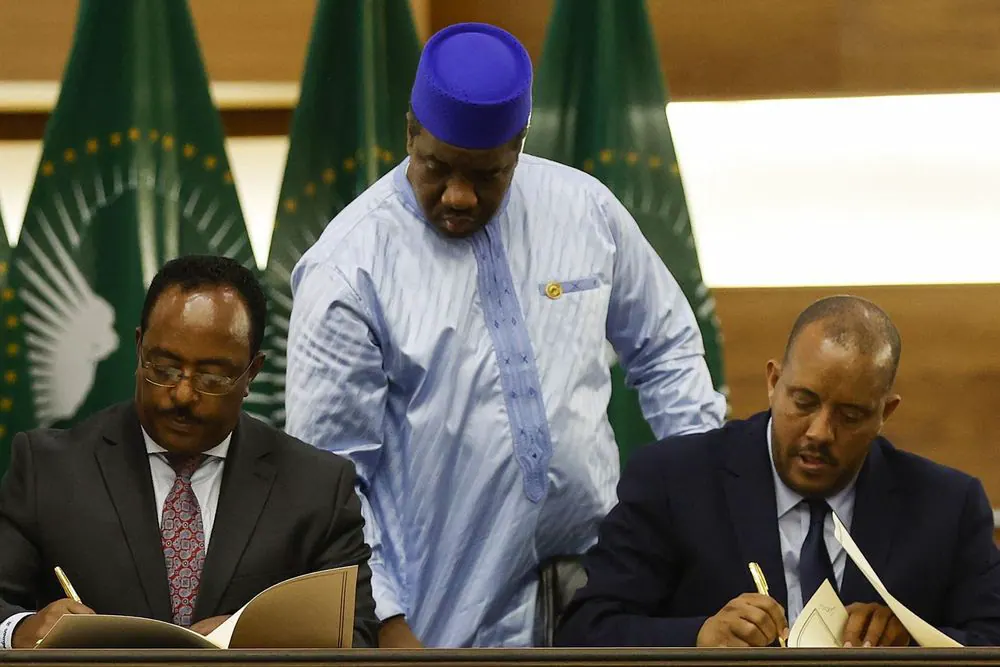
Ethiopia's fragile peace deal, negotiated in Pretoria in November 2022, is faltering as opposition groups form an alliance to unseat Prime Minister Abiy Ahmed's government. The Ethiopian Peoples' Forces Alliance for Survival, formed on September 20, 2026, comprises seven opposition and armed groups, including the Tigray People's Liberation Front (TPLF), the Amhara Fano National Movement, and the Oromo Liberation Army. This tactical coalition of convenience aims to replace Abiy's government with an inclusive transitional authority.
The alliance brings together former battlefield enemies, including the TPLF and Fano, who fought on opposite sides during the 2020-2022 Tigray war. The TPLF and Amhara forces clashed during the war, while Fano initially fought alongside the federal government against the TPLF before turning against Addis Ababa. The Oromo Liberation Army has a history of armed struggle against the Ethiopian state in Oromia. Their differing territorial ambitions, political traditions, and visions for Ethiopia pose significant challenges to the alliance's unity.
Fighting has erupted in southern Tigray, Amhara, and Afar, with federal airstrikes and drone attacks hitting targets in southern Tigray on September 22. Tigrayan forces seized airports in Mekelle, Axum, and Shire on September 23, while clashes between Tigrayan units and Fano fighters with federal troops have been reported in Amhara. Médecins Sans Frontières reported that hospitals in Korem and Alamata received over 420 war-wounded between September 22 and 25, while Suhul Hospital in Shire received over 300.
The conflict has resulted in significant humanitarian concerns, including forced recruitment of children and disruptions to communications in Tigray and parts of Amhara. By September 27-28, federal forces claimed to have regained control of Sekota in Wag Hemra, while Tigrayan forces claimed control over Erebti. The Ethiopian army reported killing 272 Tigrayan fighters in North Wollo, although this figure has not been verified.
The international community has expressed concern over the escalating violence, with United Nations High Commissioner for Human Rights Volker Türk calling for immediate de-escalation to avoid a return to full-scale war. The 2022 African Union-facilitated Pretoria agreement, which ended two years of war between the federal government and the TPLF, did not address territorial disputes or issues of identity, political power, and sovereignty.
The status of disputed territories, particularly Western Tigray, remains unresolved, and displaced people have yet to return home. The relationship between Addis Ababa and Tigray has not healed, with political tensions rising sharply this year. The TPLF restored the regional legislative council in May, and June's election did little to resolve Ethiopia's legitimacy problem, with some opposition parties boycotting the vote.
The consequences of renewed war in Ethiopia will extend far beyond Tigray, threatening regional security and economy. Escalation will impact trade routes linking Ethiopia to Djibouti and drive forced migration toward Sudan and other neighboring states. The conflict could also inflame existing regional disputes, particularly given Ethiopia's tense relationship with Eritrea and unresolved disputes with Sudan.
Key points
- The Ethiopian Peoples' Forces Alliance for Survival, formed by seven opposition and armed groups, aims to unseat Prime Minister Abiy Ahmed's government.
- The 2022 Pretoria agreement did not bring lasting peace, and the conflict has resulted in significant humanitarian concerns.
- The international community has expressed concern over the escalating violence, with the UN calling for immediate de-escalation to avoid a return to full-scale war.