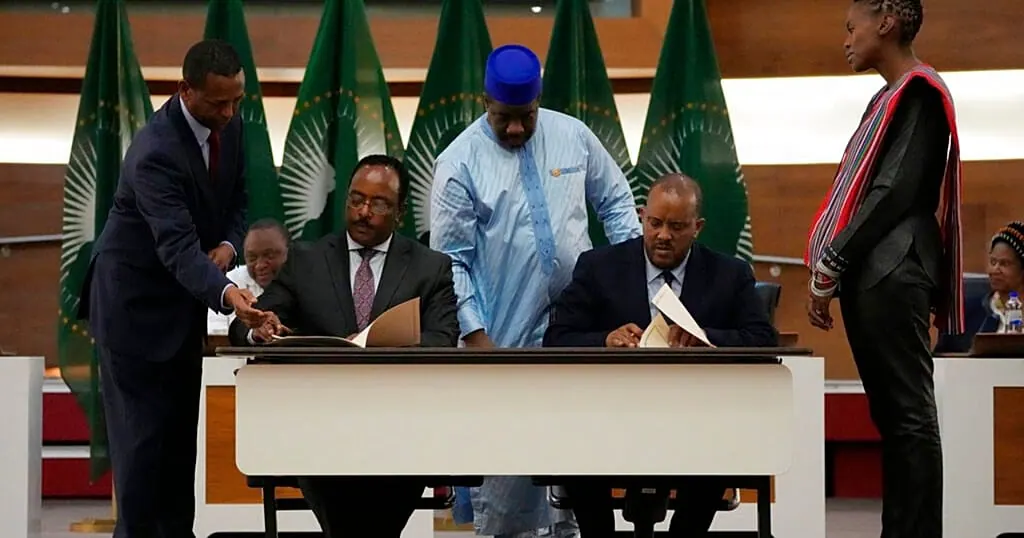
Nearly four years after a peace agreement ended Ethiopia's devastating war in Tigray, fighting has erupted again. Tigrayan forces have seized control of airports in the northern region, and clashes have been reported in Tigray and neighbouring Afar and Amhara. Both sides have accused each other of triggering the latest escalation. The renewed fighting has shattered the relative calm that followed the November 2022 peace agreement and raised concerns about a wider conflict.
Ethiopia's current federal system was established in the 1990s, following the fall of the military government of Mengistu Haile Mariam. The 1995 constitution divided the country into regional states and recognised the rights of Ethiopia's "nations, nationalities and peoples". Article 39 gives these groups rights to self-determination, including a constitutional route to secession, as well as rights relating to language, culture and self-government.
The conflict between Addis Ababa and the Tigray regional government demonstrates the problem of balancing regional autonomy with federal authority. The Tigray People's Liberation Front (TPLF) had been the dominant force within Ethiopia's ruling coalition for about three decades before Prime Minister Abiy Ahmed came to power in 2018. Abiy adjusted the ruling coalition into the Prosperity Party, reducing the TPLF's role in national politics, leading to deteriorated relations between the federal government and Tigray's regional authorities.
One of the key disputes concerned elections, which eventually led to a military confrontation. The war lasted two years and caused hundreds of thousands of deaths, according to estimates cited by the African Union and international organizations. The November 2022 Pretoria agreement ended the large-scale fighting but did not resolve every political and territorial question surrounding the conflict.
The territorial question remains a difficult issue, particularly in Western Tigray, also known as Welkait. The territory has been claimed by competing Tigrayan and Amhara interests and was one of the major areas of fighting during the war. The status of the territory, the return of displaced people and questions about future administration remain important elements of the post-war political dispute.
For the federal government, the conflict with the TPLF has been framed largely around constitutional authority and the ability of the national government to exercise power across the country. For the TPLF, the dispute has also been closely connected to the question of regional autonomy. These positions reflect different interpretations of Ethiopia's constitutional order.
Ethiopia's federalism debate cannot be understood through Tigray alone, as the country has also experienced serious armed conflicts in Amhara and Oromia. In Amhara, Fano groups fought alongside federal forces during the Tigray war before relations with the government deteriorated. The federal government announced plans to dismantle regional special forces and integrate them into federal or regional security structures, leading to continued conflict.
Key points
- The conflict in Tigray exposes the challenges of balancing regional autonomy with federal authority in Ethiopia's system of multinational federalism.
- The territorial question, particularly in Western Tigray, remains a difficult issue in the post-war political dispute.
- Ethiopia's federalism debate is not limited to Tigray, as the country has experienced serious armed conflicts in Amhara and Oromia.