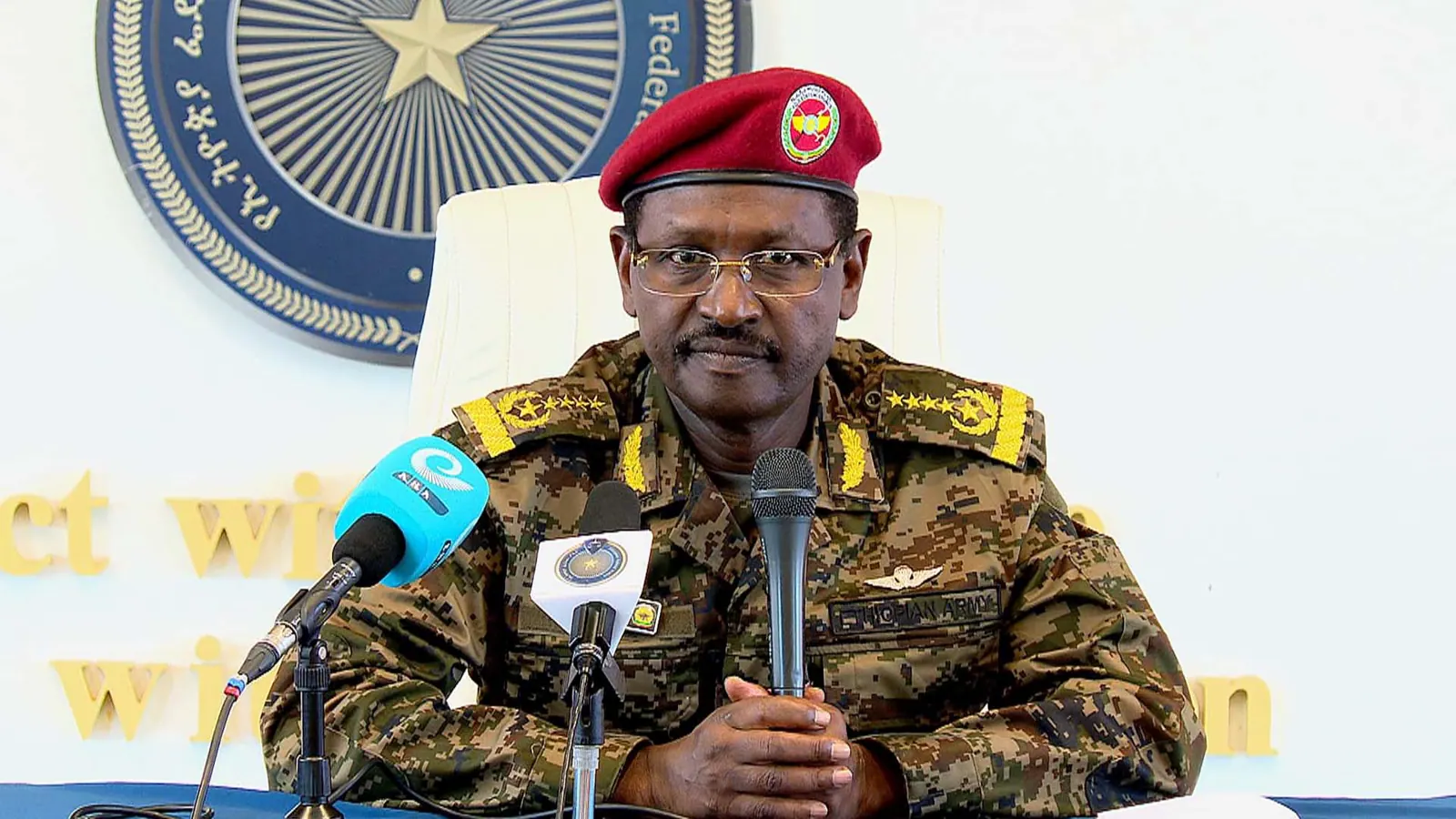
Field Marshal Birhanu Jula, Chief of the Ethiopian National Defense Force (ENDF), has accused Egypt, Sudan, and other foreign powers of supporting armed groups and political factions seeking to undermine the Ethiopian government. In a statement to military media, Birhanu Jula claimed these foreign powers have shifted their tactics from direct military confrontation to using economic and intelligence means to create internal conflict and instability. He cited the recent formation of the Ethiopian Peoples' Forces Alliance for Survival, a coalition of seven armed and political groups, as evidence of these efforts.
The Ethiopian Peoples' Forces Alliance for Survival, which includes the Tigray People's Liberation Front (TPLF), the Amhara National Movement (Fano), and the Oromada Liberation Army (OLA), among others, aims to overthrow Prime Minister Abiy Ahmed's government and establish an interim administration. Birhanu Jula referred to this coalition as "Tsimdo," suggesting it is a continuation of previous political and military alliances rather than a new entity. He also accused Eritrea, which he referred to as "Shaebia," of facilitating connections between foreign powers and internal armed groups.
According to Birhanu Jula, the TPLF and Eritrea alone do not possess the capacity to challenge the federal government, but with support from Sudan, Egypt, and other foreign powers, they pose a significant threat. The Ethiopian government and Prime Minister Abiy Ahmed have previously accused Eritrea of supporting armed groups within Ethiopia, allegations Eritrea has denied. Birhanu Jula's comments come amid heightened tensions in northern Ethiopia, where clashes and military activities have resumed.
The ENDF chief compared the new coalition to the pre-1991 political and military landscape, suggesting it seeks to establish a broad network similar to the former Ethiopian People's Revolutionary Democratic Front (EPRDF). He noted that the TPLF has historically relied on alliances with various political and armed groups and is now seeking partnerships with Amhara and Oromada groups. Birhanu Jula warned that attempts to escalate tensions could have severe consequences for the Tigray region.
Birhanu Jula also addressed the current state of the Ethiopian military, highlighting reforms and modernization efforts initiated in 2018. He emphasized the military's focus on developing domestic defense capabilities, reducing reliance on foreign equipment, and enhancing digital capacities, including surveillance, targeting, and intelligence systems. The ENDF has reportedly expanded its production of defense equipment and modernized its air force.
Despite these efforts, Birhanu Jula acknowledged that the opposition coalition faces significant challenges in uniting its diverse member groups. He pointed to internal political, ideological, and territorial differences that could hinder the coalition's ability to coordinate and unify its military strength. The Ethiopian government has taken a cautious approach to military action, mindful of the humanitarian consequences of conflict, particularly in the aftermath of the 2020-2022 Tigray war.
The accusations by Birhanu Jula underscore the complex and volatile security situation in Ethiopia, where internal conflicts and external influences intersect. The Ethiopian government and international community will be closely watching the developments in the region, as the stability of the Horn of Africa's second-most populous country remains a pressing concern.
Key points
- Ethiopia's Field Marshal Birhanu Jula accused Egypt, Sudan, and other foreign powers of supporting armed groups seeking to destabilize the government.
- The Ethiopian Peoples' Forces Alliance for Survival, a coalition of seven armed and political groups, aims to overthrow Prime Minister Abiy Ahmed's government.
- Birhanu Jula warned that attempts to escalate tensions could have severe consequences for the Tigray region.