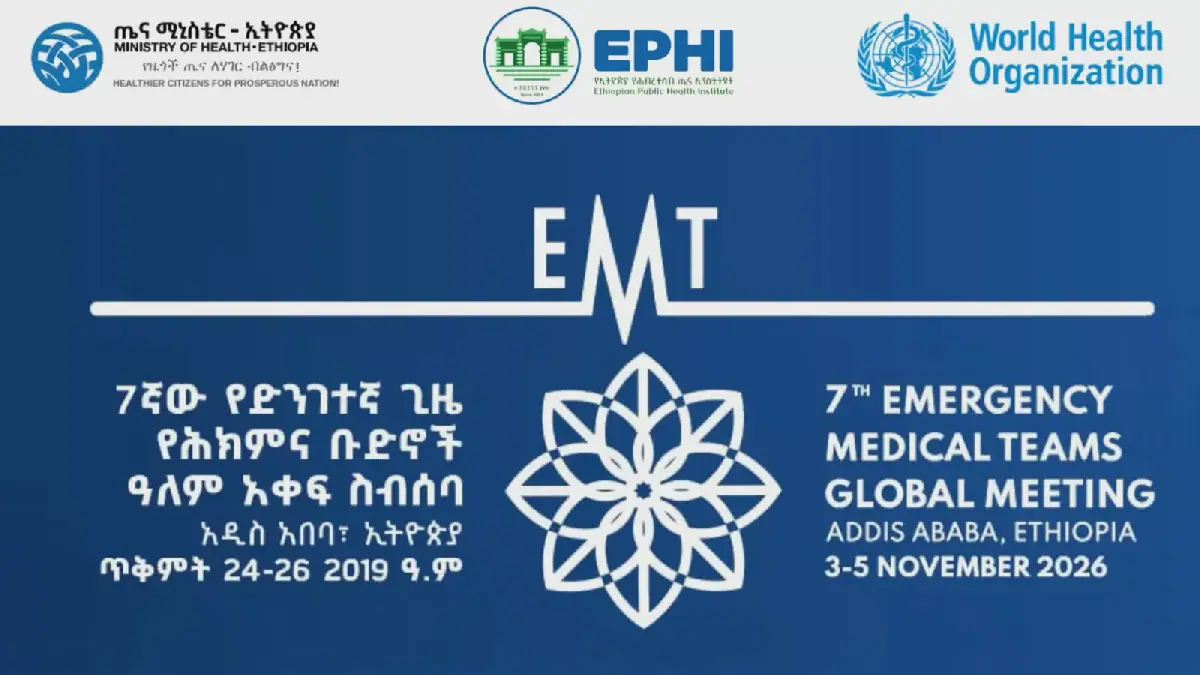
The Ethiopian government, in collaboration with the World Health Organization (WHO), is hosting the 7th Emergency Medical Teams (EMT) Global Meeting in Addis Ababa from November 3 to 5, 2026. This is the first time the meeting is being held in the WHO African Region. The event has attracted over 800 participants from more than 100 countries. The meeting aims to enhance countries' capacity to provide timely and quality clinical care during emergencies.
The meeting is guided by the EMT 2030 Strategy and lessons learned from recent emergencies. Discussions will focus on sustainable financing, quality standards, operational readiness, and international cooperation. These are crucial elements in establishing nationally led EMT programs that strengthen the health emergency workforce and support health services under pressure. The goal is to advance the development of national emergency medical teams.
Emergency Medical Teams are groups of health professionals trained and equipped to provide care during outbreaks, disasters, conflicts, and other emergencies. They support the affected country's health system, working under national coordination and according to agreed standards for safe, quality care. Ethiopia's national EMT recently achieved WHO international classification after an assessment of its clinical services, logistics, and operational readiness against international standards.
Across the WHO African Region, 30 countries are developing national EMT capacities, supported by the Regional Framework on Emergency Medical Teams 2026–2030. The Regional EMT Training and Knowledge Hub in Addis Ababa provides a platform for training, simulation exercises, and exchange of expertise. WHO supports this work through technical guidance, mentoring, and readiness assessments.
Building a national team involves practical decisions about who can be released from regular duties, how equipment will be transported, and how deployments will be funded. Countries can learn from one another's experience in addressing these challenges while helping partners understand where support is most needed. Professor Francis Chisaka Kasolo, WHO Representative to Ethiopia, emphasized the importance of strong national teams in responding quickly and organizing assistance according to local needs.
The meeting provides an opportunity for countries and partners to identify investment needs and define their contributions. Sustained financing, regular training, and reliable deployment systems are essential for teams to respond effectively. The event brings countries' experience directly into the global discussion, allowing for agreement on how to better support teams before an emergency and work together during a response.
The EMT global meeting is supported by various partners, including Macao SAR and the Robert Koch Institute. The outcome of the meeting is expected to enhance global collaboration and coordination in emergency medical response. By sharing experiences and best practices, countries can strengthen their national EMT capacities and improve their response to health emergencies.
Key points
- Over 800 participants from 100 countries are attending the 7th Emergency Medical Teams global meeting in Ethiopia.
- The meeting focuses on strengthening countries' capacity to provide timely, quality clinical care during emergencies.
- Ethiopia's national EMT achieved WHO international classification in September 2026.