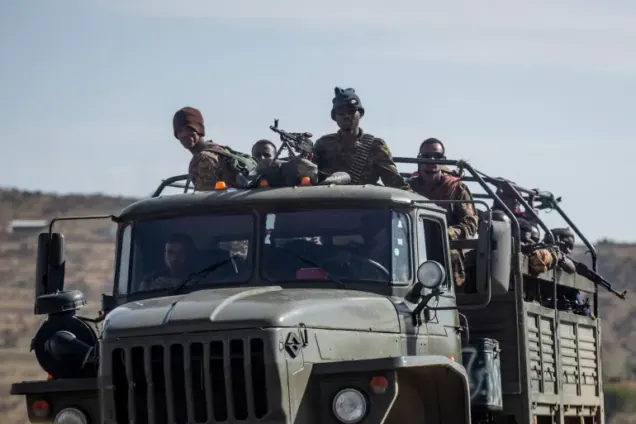
Ethiopia's federal military has said it is handling rising tensions in the country's north with restraint, as fears grow that Ethiopia could be heading towards another civil war. Army Chief of Staff Field Marshal Berhanu Jula said the army was responding to provocations from the Tigray front with "wisdom and restraint".
The recent military developments have been marked by accusations from Ethiopia's army that Eritrea is funding and supporting armed groups to weaken Ethiopia. Field Marshal Berhanu Jula described the "Tsimdo" alliance as an extension of a longstanding pattern of hostile alliances. Eritrea has denied these accusations, wary that landlocked Ethiopia may be seeking to invade it to gain access to the Red Sea.
The fighting has spread from Tigray into neighbouring Afar and Amhara regions after seven armed groups announced an alliance, the Ethiopian Peoples' Forces Alliance for Survival, committed to removing Prime Minister Abiy Ahmed's government. In Afar, battles have taken place around Abala, where the military has been trying to prevent rebels from seizing control.
The army reported heavy losses for the Tigray People's Liberation Front (TPLF) in a counter-offensive in North Wollo, a zone of Amhara bordering Tigray. It said 272 Tigrayan fighters were killed and 260 wounded. The TPLF's Tigray Army said the federal government had launched a "full-scale offensive" involving infantry, mechanised units and drones.
The army command said it prefers a strategy of "strategic calm" over a large-scale military confrontation, arguing the Tigray front's popular support is dwindling and its leadership divided. Internet access was reportedly cut across northern Ethiopia on Friday, a day after the UN said it was alarmed by reports of drones being used against civilians there.
The renewed fighting has put the 2022 Pretoria Agreement, which ended a brutal two-year civil war in Tigray, under severe strain. It comes weeks after Washington lifted sanctions on Ethiopia and Eritrea tied to atrocities from the last war. Ethiopia's president sought to portray the country as a force for regional stability at the UN General Assembly.
Some analysts blame the federal government for the collapse of the Pretoria Agreement. Alemayehu Weldemariam, a professor of law at Indiana University, cited fuel, service and cash restrictions imposed on Tigray, and the government's failure to set up the interim administration the deal had promised.
Key points
- The Ethiopian army has vowed to handle rising tensions in the country's north with restraint.
- The renewed fighting has put the 2022 Pretoria Agreement under severe strain.
- Analysts blame the federal government for the collapse of the Pretoria Agreement.