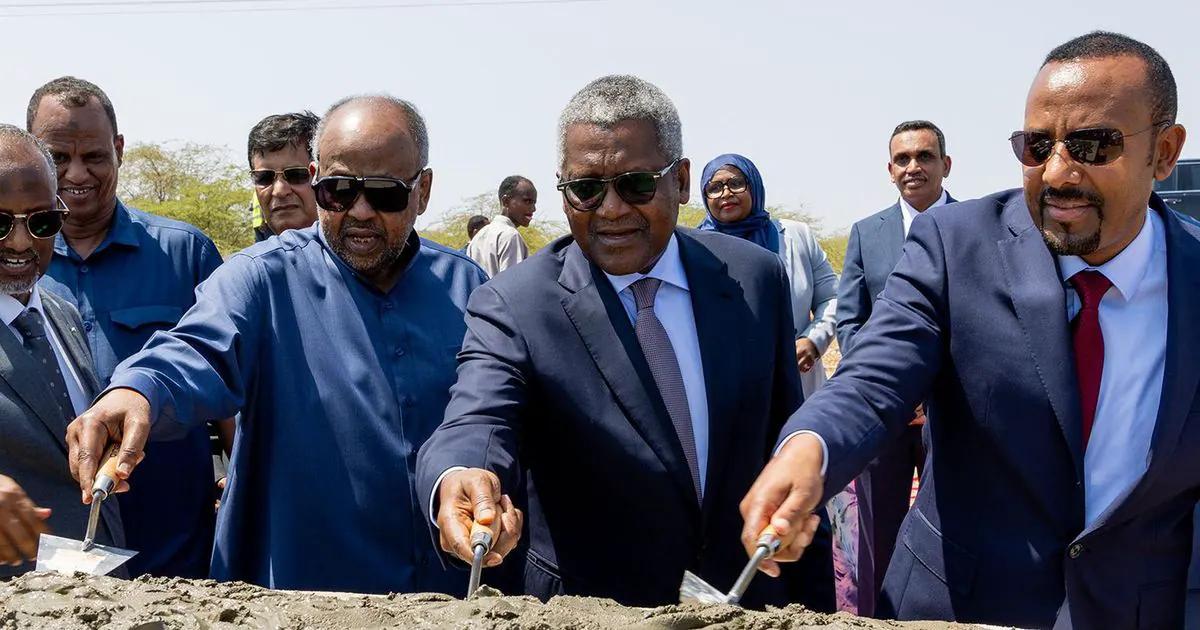
Ethiopian Investment Holdings (EIH) and the Dangote Group have commenced construction on a $660 million joint venture pipeline project aimed at transforming Ethiopia's fuel logistics. The pipeline, which will span 120 kilometers from the Damerjog petroleum terminal on the Djiboutian coast to Dewele on the Ethiopian border, seeks to replace the existing road-tanker fleet that has been hauling the country's imported fuel for decades. The groundbreaking ceremony was attended by high-ranking officials, including Prime Minister Abiy Ahmed and Djibouti President Ismail Omar Guelleh.
The new pipeline project marks a significant departure from previous, larger pipeline proposals that stalled over the years. The 2015 attempt, proposed by Blackstone-backed Black Rhino Group and MOGS, envisioned a 550-kilometer pipeline running from Damerjog to Awash in central Ethiopia at a cost of $1.5 billion. However, this project never materialized. In contrast, the EIH-Dangote pipeline will have a much shorter route and feature massive border storage facilities, cutting the capital bill by nearly $840 million.
The pipeline will connect directly into the Damerjog-Nagad railway line and a shared collector system at the port, allowing fuel to move from ship to depot without the need for separate trucking. The two ends of the line will have a combined storage capacity of 1.17 million cubic meters of fuel, equivalent to approximately 39,000 full fuel-truck loads. Damerjog's terminal will have a capacity of 375,000 cubic meters, while Dewele's depot will be more than double that, at 800,000 cubic meters.
The Dewele depot will also be linked to Ethiopia's rail network, enabling fuel arriving from Djibouti to be transported onward by both truck and train. This development is expected to significantly reduce the number of truck trips required to transport fuel, with the pipeline designed to take off approximately 200,000 truck trips annually. According to EIH chief executive Dr. Bruk Taye, the pipeline is expected to take two years to complete, with the goal of removing logistical challenges and reducing losses associated with road transport.
The $660 million investment will be built in phases, starting with an initial $160 million tranche. This project extends a partnership between EIH and Dangote, which began with a $2.5 billion urea fertilizer complex in Gode in August 2025. The pipeline is part of a larger $50 billion continental investment plan by Dangote, which aims to increase its cement capacity to 100 million tonnes within four years and expand its petroleum refinery to 1.4 million barrels a day.
The project is expected to have a positive impact on Djibouti, with increased port throughput, added revenue, and jobs. The Damerjog rail and collector links are designed to keep traffic flowing through Djiboutian infrastructure, solidifying the country's role as a regional transit hub. For Ethiopia, the pipeline is anticipated to reduce dependence on Djiboutian port congestion and road haulage for its fuel supply.
The pipeline project is set to be commissioned within 18 months, with an expected completion date of two years. Once operational, it will significantly improve Ethiopia's fuel logistics and contribute to the country's economic growth. The project is a key component of Ethiopia's efforts to modernize its infrastructure and increase its economic competitiveness.
Key points
- The pipeline project will reduce Ethiopia's dependence on Djiboutian port congestion and road haulage for its fuel supply.
- The project will cut approximately $840 million off the capital bill compared to the previous pipeline proposal.
- The pipeline is expected to take off approximately 200,000 truck trips annually, reducing logistical challenges and losses associated with road transport.