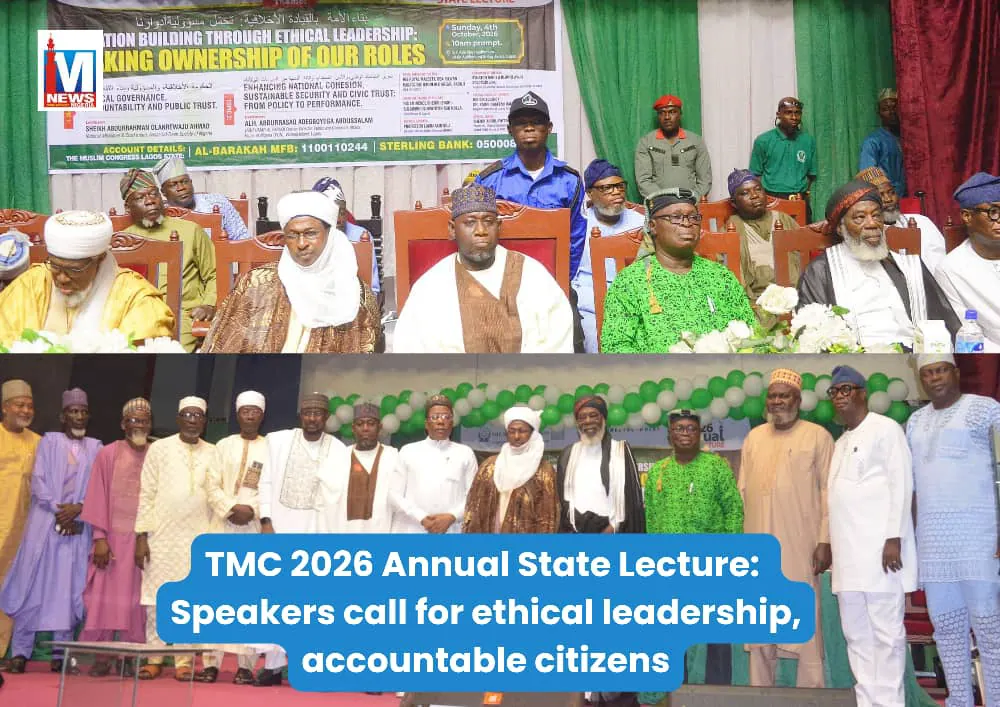
Muslim scholars and public affairs experts have emphasized the need for ethical leadership, accountable governance, and responsible citizenship to rebuild public trust and advance Nigeria's development. The call was made at the 2026 Annual State Lecture of The Muslim Congress, TMC, Lagos State, held at the University of Lagos. The annual lecture, which took place on October 4, is part of TMC's efforts to provide a platform for public engagement on critical national issues.
The speakers, who spoke on the theme "Nation Building Through Ethical Leadership: Taking Ownership of Our Roles," stressed that Nigeria's leadership challenges cannot be addressed by government alone. They emphasized that citizens must also take responsibility for their roles in strengthening the country. Former Director of Public and Corporate Affairs, Voice of Nigeria, Alhaji Abdurrasaq Adegbooyega Abdussalam, noted that public trust requires ethical governance and accountability. He explained that when citizens lose confidence in government, they may resort to self-help, leading to insecurity, corruption, and social dislocation.
Abdussalam identified access to public funds, the desire for power and control, and the pursuit of personal recognition as motivations for seeking political power. He warned that political office can become dangerous when those occupying positions of authority begin to see themselves as all-powerful and beyond scrutiny. Abdussalam stressed that public office must be understood as a trust and an opportunity to serve rather than a means of personal enrichment.
National Missioner and Chief Imam of Ansor Ud Deen Society of Nigeria, Sheikh Abdurrahman Olanrewaju Ahmad, challenged Nigerians to become more active in demanding accountability from elected leaders. He urged citizens to question officials about their promises, policies, and management of public resources. Sheikh Ahmad emphasized that accountability operates in different directions, with citizens, the media, government institutions, and elected officials all having roles to play.
Keynote speaker and Director of the Muslim Rights Concern, MURIC, Professor Lakin Akintola, said Nigeria needs transformative leadership anchored on integrity, transparency, accountability, and responsiveness. He urged politicians to keep their promises and learn from the leadership examples of prominent Islamic figures. Akintola expressed concern over the frustration of Nigerian youths, warning that the country cannot build a secure future when its younger generation continues to lose hope.
Spiritual Father of the Day and Chief Imam of Lagos, Sheikh (Engr.) Sulaimon Oluwatoyin Abu-Nolla, urged Nigerians to participate actively in the electoral process. He called on citizens to obtain their Permanent Voter Cards and use them to select leaders capable of providing responsible governance. Abu-Nolla emphasized the importance of careful evaluation of candidates, highlighting education, experience, and exposure as key qualities to consider.
Chairman of the occasion, Senator Ganiyu Olanrewaju Solomon, noted that the lectures demonstrated that successful nation-building requires the joint efforts of leaders and citizens. He emphasized that for the country to be run well, it requires not only leaders but also active and responsible citizens. The speakers' submissions were seen as crucial ahead of the 2027 elections, with a focus on promoting ethical leadership and accountable governance in Nigeria.
Key points
- Public trust requires ethical governance and accountability.
- Citizens must hold leaders accountable for their promises and actions.
- Transformative leadership anchored on integrity, transparency, and responsiveness is needed in Nigeria.