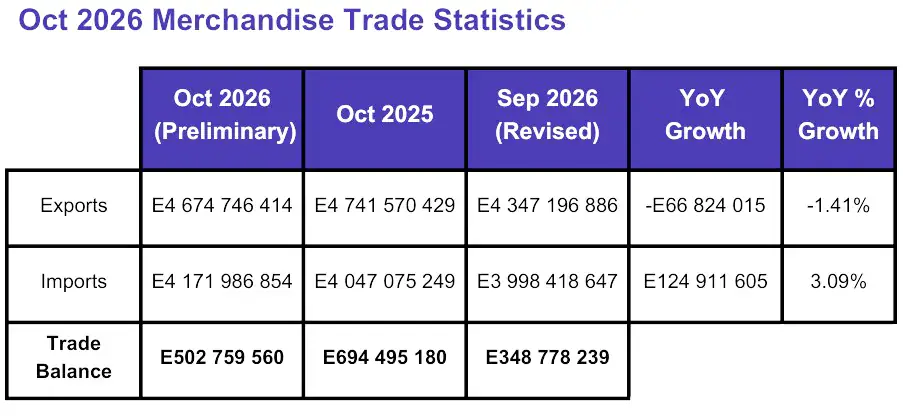
Eswatini achieved a merchandise trade surplus of E502.76 million in October, according to the Eswatini Revenue Service. The surplus was driven by exports worth E4.67 billion and imports amounting to E4.17 billion. However, this monthly surplus was lower than the E694.50 million recorded in September 2026 and also below the E694.50 million surplus recorded in October 2025.
The country's merchandise trade performance has weakened compared to the corresponding period last year, with exports declining by E66.82 million or 1.41 per cent from E4.74 billion in October 2025 to E4.67 billion in October 2026. The decline was primarily attributed to lower exports of concentrates and sugar. In contrast, merchandise imports increased by E124.91 million or 3.09 per cent from E4.05 billion in October 2025 to E4.17 billion in October 2026.
The increase in imports was largely driven by higher imports of diesel and petrol, reflecting the country's continued reliance on imported petroleum products to meet domestic energy and transport requirements. Despite the positive monthly balance, the cumulative merchandise trade position for the 2026/27 financial year has moved into negative territory, with a preliminary merchandise trade deficit of E29.90 million between April and October 2026.
Cumulative merchandise exports increased by 5.80 per cent year-on-year, rising from E25.77 billion during April to October 2025 to E27.27 billion in the corresponding period this year. However, imports grew at a slightly faster rate of 5.92 per cent, increasing from E25.77 billion to E27.30 billion. In monetary terms, exports generated an additional E1.49 billion compared to the previous financial year, while imports increased by E1.53 billion.
An analysis of merchandise exports by Harmonised System sections shows that chemical products, prepared foodstuffs, and textiles continued to account for significant portions of Eswatini's export earnings. Chemical products remained the largest export category in October, generating E2 billion, although this represented a decline of 3.96 per cent from E2.08 billion recorded in October 2025.
Certain sectors registered significant improvements, with mineral products exports increasing by 187.16 per cent from E42.60 million in October 2025 to E122.33 million in October 2026. Machinery and mechanical appliances, including electrical equipment, also recorded an increase of 49.20 per cent, rising from E61.82 million to E92.23 million. Vegetable products exports increased by 52.53 per cent from E47.91 million to E73.08 million.
On a cumulative basis, the export picture was more encouraging, with total exports increasing by 5.80 per cent to E27.27 billion. Prepared foodstuffs generated E8.80 billion between April and October 2026, up 8.88 per cent from E8.08 billion in the corresponding period last year. Chemical products contributed E10.57 billion, marginally higher than the E10.56 billion recorded previously.
Key points
- Eswatini's merchandise trade surplus declined to E502.76 million in October due to weaker exports and rising fuel imports.
Reporting sources
- Trade surplus hits E502.76m in October · Times of Swaziland