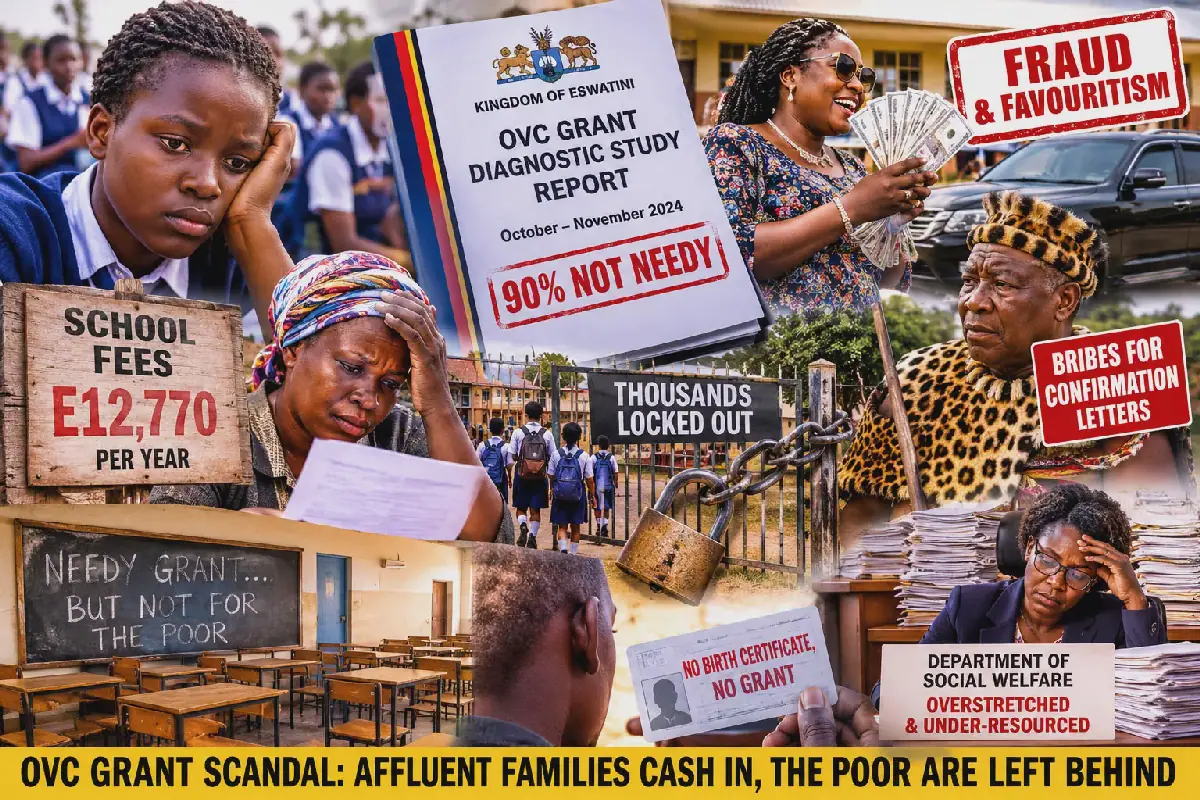
A recent report has raised concerns about the possible abuse of the Orphaned and Vulnerable Children (OVC) grant in Eswatini, with allegations that some head teachers are registering ineligible pupils for government school grants without their parents' knowledge. The report claims that some schools are receiving government payments for learners whose parents can afford school fees, with the head teachers allegedly using the funds for their own gain.
According to the report, some head teachers are registering financially capable learners for assistance without informing their guardians, allowing the schools to receive money for approved learners. The alleged irregularities sometimes emerge when pupils reach Form V and examination registration exposes inconsistencies in fee payments. This has raised concerns about the administration of the grant and the potential conflict of interest in the selection of beneficiaries.
The report identifies a potential conflict of interest in the administration of the grant, as schools are often the first point of contact for applications and also receive and manage electronic payments from Treasury. This allows head teachers to influence beneficiary selection, while their schools receive money for approved learners. A key informant interviewed during the study accused some school administrators of exploiting the arrangement for personal gain.
The report also records allegations of favouritism in beneficiary selection, with some head teachers allegedly favouring particular families and compromising the fairness of the application process. The study notes that some head teachers have a certain level of preference for one family over another, leading to biased decision-making.
Outside the allegations against school administrators, the report identifies discrepancies in beneficiary records and expenditure. During the 2016/17 financial year, the Department of Social Welfare administrative records indicated that 52,632 beneficiaries received assistance at a cost of E142 million against a budget of E167 million. However, the national household survey data for the same period estimated that 17,600 people benefitted from the programme, a difference of 35,032 beneficiaries.
The study also identifies variations in government payments per learner, with government reportedly paying an average of E2,067 per learner in 2019/20 against a gazetted junior secondary grant of E1,950. In 2024/25, the average tuition payments had reportedly fallen to E1,379 per learner, despite beneficiary numbers increasing by more than 7,000 over two years.
The allegations raise questions under the Prevention of Corruption Act, 2006, which criminalises certain corrupt dealings involving public officers and agents. The Public Finance Management Act, 2017, provides a framework for accounting for and auditing public expenditure. The Anti-Corruption Commission (ACC) is empowered to investigate suspected corrupt practices and refer appropriate cases to the Director of Public Prosecutions.
Key points
- Some head teachers in Eswatini are accused of registering ineligible pupils for government school grants, fuelling allegations of fraud and favouritism.
- The report identifies discrepancies in beneficiary records and expenditure, with variations in government payments per learner.
- The allegations raise questions under the Prevention of Corruption Act, 2006, and the Public Finance Management Act, 2017.
Reporting sources
- Some head teachers accused of OVC grant fraud · Times of Swaziland