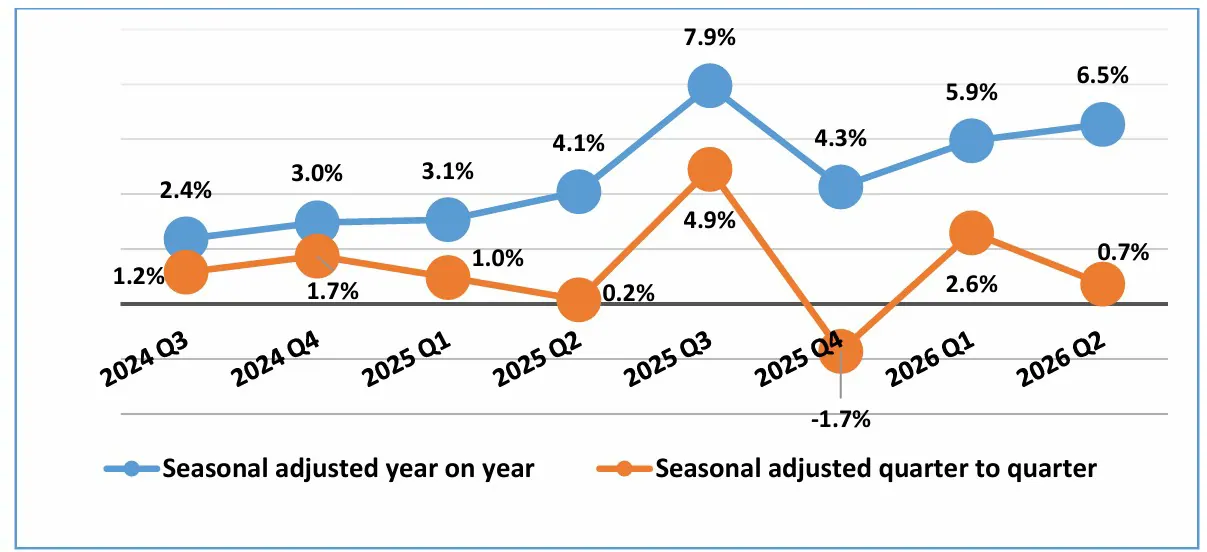
Eswatini's real gross domestic product (GDP) grew by 6.5% in the second quarter of 2026, according to the Central Statistical Office (CSO). This represents a significant acceleration from the 4.1% growth recorded in the same period last year. The growth was driven by a broad-based expansion across the economy, with the primary, secondary, and tertiary sectors all recording year-on-year growth during the quarter.
The primary sector, which accounts for 8.9% of total industries, recorded growth of 9.3% year-on-year in the second quarter. This was driven by growth in crops, forestry, and mining, which expanded by 6.5%, 6.9%, and 24.3%, respectively. Mining was one of the fastest-growing activities during the quarter, providing a significant contribution to the primary sector's expansion.
The secondary sector recorded the strongest overall sectoral growth, expanding by 11.6% year-on-year in the second quarter. This sector contributes 35.2% to total industries, according to the CSO. Manufacturing increased by 14.0%, while electricity supply grew by 21.8%. These two activities were the main drivers of the secondary sector's performance during the quarter.
The tertiary sector, which remains the largest component of economic activity, grew by 4.1% year-on-year during the second quarter. This sector accounts for 55.8% of total industries, with its performance mainly supported by accommodation, information and communication, and professional services. Accommodation grew by 19.6%, while information and communication recorded a substantial 55.6% expansion.
On a quarter-to-quarter basis, seasonally adjusted GDP growth moderated to 0.7% in the second quarter, following growth of 2.6% in the first quarter of 2026. At current prices, GDP increased to E24.044 billion in the second quarter of 2026, compared to E22.496 billion in the corresponding quarter of 2025.
The CSO said the quarterly GDP estimates had been benchmarked using updated rebased annual GDP figures. The previous base year was 2011, while the updated base year is now 2019. The statistical agency said the rebasing was intended to align GDP estimates with current economic conditions and structural changes in the economy.
The latest estimates were compiled using the 2008 System of National Accounts and the International Standard Industrial Classification of Economic Activities, Revision 4. At constant prices, GDP stood at E18.721 billion in the second quarter, up from E17.505 billion in the same quarter of 2025. The seasonally adjusted constant-price GDP increased from E18.576 billion in the second quarter of 2025 to E19.791 billion in the latest quarter.
Key points
- Eswatini's economy grew by 6.5% in Q2 2026, driven by broad-based growth across the primary, secondary, and tertiary sectors.