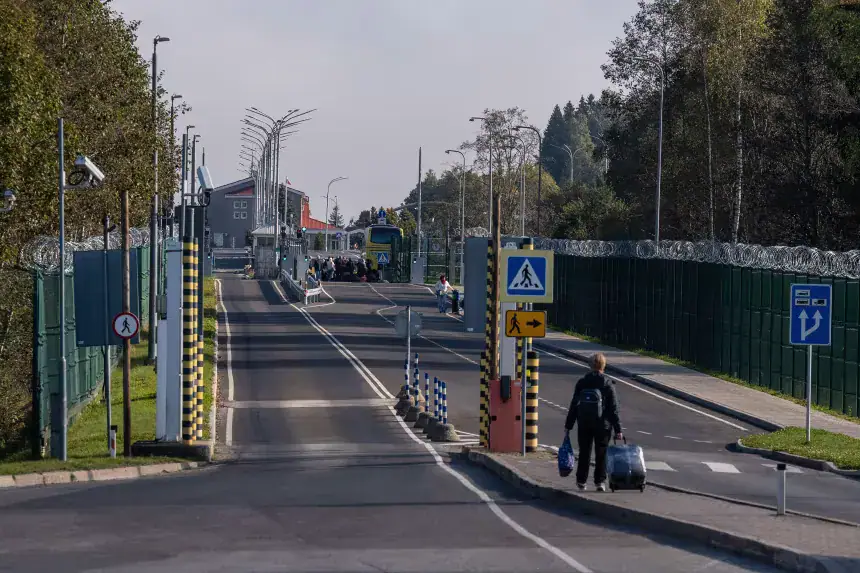
Estonian Prime Minister Kristen Michal announced on Sunday that the country will close its border with Russia, effective December 1, in response to a foiled arson plot targeting a defense technology company. Eight individuals were detained for allegedly attempting the attack overnight on Saturday, which Estonian security services claim was orchestrated by Russia's military intelligence service, the GRU. Fortunately, no one was injured in the incident.
The attempted attack is part of a broader pattern of "hybrid operations" that Estonia believes Russia is conducting against it. Prime Minister Michal emphasized that closing the border will reduce the threat to Estonian citizens and send a clear message that attacks on the country's defense industry and capabilities are unacceptable. He also noted that Russian intelligence services often exploit border crossings to exert influence over people.
Russian Foreign Ministry spokesperson Maria Zakharova responded to Estonia's decision, stating that it is part of a wider pattern of "Russophobia." Zakharova expressed skepticism about the veracity of the claims, but acknowledged that if Estonia's plans are genuine, they represent another example of aggressive and unbridled Russophobia. Estonia's Foreign Minister Margus Tsahkna, however, sees the attempted sabotage as a reminder that Russia's hostile activities extend far beyond Ukraine.
Tsahkna expects further sanctions to be adopted targeting Russian individuals and entities at a meeting of foreign affairs ministers in Brussels, Belgium on Monday. He emphasized that hostile actions must have consequences. Ukraine has commended Estonia for its move, hailing it as an example of effective action against Russian hostility and encouraging Europe to take note. Ukrainian Foreign Minister Andrii Sybiha praised Estonia's approach, saying it deserves wider support across Europe.
Russia has long been accused of carrying out sabotage and other hybrid attacks against Europe, but has repeatedly denied the claims. In September, European officials pointed to the Kremlin as the culprit behind a series of incidents targeting NATO members. These incidents included a railway line being struck by a Russian drone near Ukraine's border with Poland and a drone being shot down in Lithuania.
A third drone washed ashore in Poland, and other incidents involved a Danish helicopter narrowly missing a Russian flare and Dutch rail traffic being disrupted by metal pipes fitted across the tracks. Despite denying involvement, Moscow has remained the alleged culprit. European NATO-member allies have deemed these actions an escalation of conflict against the bloc, characterizing them as measures designed to antagonize without triggering all-out war.
The international community will be watching Estonia's border closure and its potential impact on relations with Russia. As the situation unfolds, Estonia's actions will likely be seen as a test of Europe's resolve to counter Russian aggression. The effectiveness of Estonia's approach and its implications for the region will be closely monitored in the coming weeks and months.
Key points
- Estonia blames Russia's GRU for foiled arson plot targeting defense technology company
- Border closure aims to reduce threat to Estonian citizens and counter Russian hybrid operations
- Incident highlights escalating conflict between Europe and Russia, with Ukraine urging wider support for Estonia's approach
Reporting sources
- Estonia to shut its border with Russia, blaming Moscow for foiled arson plot · Egypt Independent