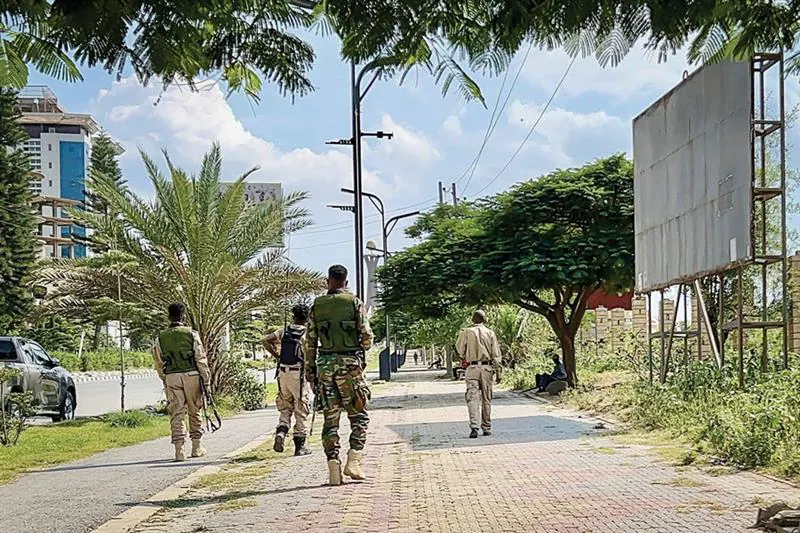
The Ethiopian government and Tigrayan forces have renewed clashes, escalating tensions in the region. The conflict began on September 23, 2026, and has spread to neighboring Amhara and Afar regions. This development raises concerns about the stability of the Pretoria peace agreement, signed in November 2022, which had brought an end to two years of devastating fighting. The agreement had paved the way for the gradual restoration of essential services, disarmament, and reintegration.
The Tigray People's Liberation Front (TPLF) and other armed groups, including the Amhara nationalist militia Fano and the Oromo Liberation Army (OLA), have formed an alliance to overthrow the government of Prime Minister Abiy Ahmed. This new alliance has added complexity to the situation, with various groups having different territorial claims and political objectives. The TPLF has taken control of airports in Mekele, Aksoum, and Shire, while clashes have erupted along several axes separating Tigray from Amhara and Afar.
Both sides blame each other for the escalation, with the government accusing Tigrayan forces of launching an offensive and the TPLF claiming to be responding to federal attacks. This war of narratives makes it challenging to independently assess the situation. According to Hussein Al-Behery, an expert on African affairs, the crisis directly tests the Pretoria peace agreement. The agreement had ended two years of fighting but left several issues unresolved, including contested territories between Tigray and Amhara.
The new alliance represents a significant change, with the TPLF now associated with forces that have previously fought alongside or against them. However, this convergence is fragile, and the groups have different claims and objectives. Al-Behery notes that the situation is different from 2020, when the TPLF had strong internal cohesion, allowing it to resist a coalition of federal and Eritrean forces. Today, the movement is divided and faces increased competition.
The conflict's expansion to neighboring countries is a significant risk. The Ethiopian government has accused Eritrea of financially supporting the new alliance, which Eritrea denies. If Eritrean support is established, the conflict could take on a regional dimension, similar to the previous war. This scenario is particularly concerning in the Horn of Africa, already destabilized by the war in Sudan.
There are three possible developments: a prolonged and multifaceted war without a quick military victory, a regional expansion if Eritrea becomes directly involved, or diplomatic mediation to reactivate the Pretoria agreement. Al-Behery emphasizes that the stakes go beyond Tigray, and if the fighting remains contained, negotiation could preserve the Pretoria agreement's gains. However, if the fronts converge and armed alliances solidify, Ethiopia may enter a larger conflict than the 2020-2022 war.
The situation in Ethiopia remains volatile, with the international community watching closely. The conflict's impact on regional stability and the humanitarian situation in the Tigray region is a significant concern. The Pretoria agreement's fate and the future of the Ethiopian government hang in the balance as the conflict continues to escalate.
Key points
- The resumption of fighting between federal forces and Tigrayan forces threatens the Pretoria peace agreement and regional stability.
- The new alliance between the TPLF and other armed groups adds complexity to the conflict.
- The conflict's expansion to neighboring countries, particularly Eritrea, is a significant risk.