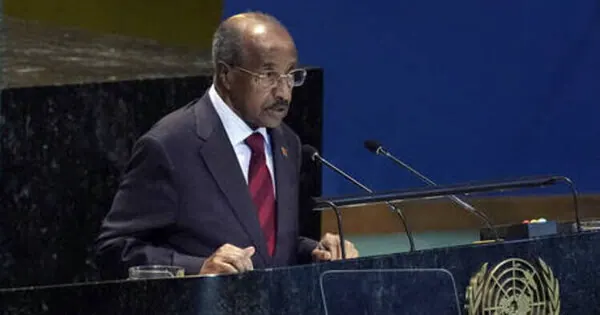
Eritrean Foreign Minister Osman Saleh has warned that a confrontation with Ethiopia would devastate both countries and destabilize the region. In a letter to the UN Security Council, Saleh rejected Ethiopia's claim that it was acting in self-defense as "deceitful attempts to rationalize its brazen acts of war against a sovereign UN member State." Eritrea's appeal follows Ethiopia's notification to the Security Council that Eritrean forces had advanced up to 60 km inside the northern Tigray region.
Ethiopia's notification to the Security Council last week claimed that Eritrean forces, including mechanized units, had entered the northern Tigray region. Foreign Minister Gedion Timothewos sought international support for Ethiopia's right to self-defense, demanded the immediate withdrawal of the troops, and called for the UN to unequivocally condemn the alleged incursion. Eritrean Information Minister Yemane Gebremeskel rejected the accusations, calling them "audacity and duplicity in their most extreme forms."
The confrontation comes amid renewed fighting in northern Ethiopia after the Tigray People's Liberation Front (TPLF) formed an alliance with six other armed groups last month to overthrow the federal government. TPLF forces seized airports in Mekelle, Tigray's regional capital, and the cities of Axum and Shire. Federal troops and allied fighters retook Mekelle on October 4 following the TPLF's withdrawal. At least 52 civilians were killed around Alamata in southern Tigray in late September.
More than 720 wounded people had been admitted to hospitals in Korem, Alamata, and Shire by September 25, according to Doctors Without Borders. Ethiopia accuses Eritrea of supporting the armed groups, which Asmara denies. Eritrean troops fought alongside Ethiopia's federal army during the 2020-2022 Tigray war, but relations have since soured over Addis Ababa's maritime ambitions.
On October 1, Asmara severed diplomatic ties with Ethiopia after it expelled ten Eritrean diplomats and closed its embassy in Eritrea. Ethiopia became landlocked when Eritrea gained independence in 1993. Prime Minister Abiy Ahmed calls sea access an existential issue and says it should be secured through peaceful dialogue, while Asmara sees his government's ambitions as a threat to its sovereignty.
Eritrea has requested the UN Security Council to forcefully condemn Ethiopia's declaration of war and take deterrent measures against it in accordance with Chapter VII of the UN Charter. Those provisions allow sanctions and military action. US-based conflict monitor ACLED reported multiple suspected Ethiopian drone strikes targeting Eritrean troops and ammunition in the area on Wednesday and Thursday.
The violence has sparked fears of a return to full-blown war in the East African country, which has struggled to maintain stability since a peace deal in November 2022 ended a brutal two-year conflict in Tigray. Eritrean Foreign Minister Osman Saleh warned that a confrontation would have severe consequences for both countries and the region.
Key points
- Eritrea has asked the UN Security Council to take deterrent measures against Ethiopia.
- Ethiopia accuses Eritrea of supporting armed groups in Tigray.
- A confrontation between Eritrea and Ethiopia would devastate both countries and destabilize the region.