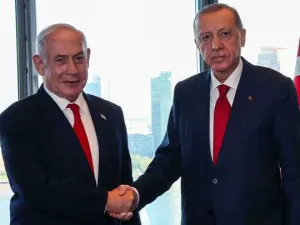
Turkish President Recep Tayyip Erdogan has responded to Israeli Prime Minister Benjamin Netanyahu's recent speech at the United Nations, in which Netanyahu described Erdogan as a "tyrant". In a speech in Istanbul, Erdogan stated that those who commit war crimes should be held accountable in court, not on the UN platform. He emphasized that perpetrators of genocide must face justice, law, and history.
Erdogan's comments come after Netanyahu's speech at the UN, where he launched a personal attack on Turkey, accusing it of spreading anti-Semitic lies. Netanyahu also described Erdogan as a "tyrant" and accused him of detaining journalists and hosting Hamas leaders. Erdogan's response highlights the strained relations between Turkey and Israel, with the Turkish leader vowing to expose the "occupation mentality" of Israel.
In his speech, Erdogan criticized the current global order, stating that it has reached a deadlock in terms of legitimacy, representation, and justice. He emphasized that the strong are dominating international relations, and that this has led to a surge in crises in the region. Erdogan's comments reflect Turkey's concerns about the current state of global affairs and its commitment to promoting justice and accountability.
Erdogan also highlighted Turkey's commitment to promoting justice and accountability, stating that those who commit crimes must face the consequences. He emphasized that the international community must work together to prevent the repetition of atrocities and to promote a more just and equitable world order. Erdogan's comments have been seen as a strong rebuke to Netanyahu's speech and a demonstration of Turkey's commitment to human rights and international law.
The exchange between Erdogan and Netanyahu reflects the complex and often tense relationship between Turkey and Israel. The two countries have had a strained relationship in recent years, with disagreements over issues such as Gaza, Palestine, and human rights. Erdogan's response to Netanyahu's speech is likely to further exacerbate tensions between the two countries.
Erdogan's speech in Istanbul was a significant event, highlighting Turkey's commitment to promoting justice and accountability. The Turkish leader's comments were seen as a strong rebuke to Netanyahu's speech and a demonstration of Turkey's commitment to human rights and international law. The incident is likely to have significant implications for Turkey-Israel relations and the broader Middle East peace process.
The incident has sparked widespread reaction, with many countries and international organizations weighing in on the debate. The United Nations has called for calm and restraint, emphasizing the need for dialogue and cooperation to resolve differences. The incident highlights the complex and often contentious nature of international relations, particularly in the Middle East.
Key points
- Erdogan calls for accountability for war crimes, criticizing Netanyahu's UN speech.
- Turkey and Israel have a strained relationship, with disagreements over issues such as Gaza and human rights.
- The incident has significant implications for Turkey-Israel relations and the broader Middle East peace process.