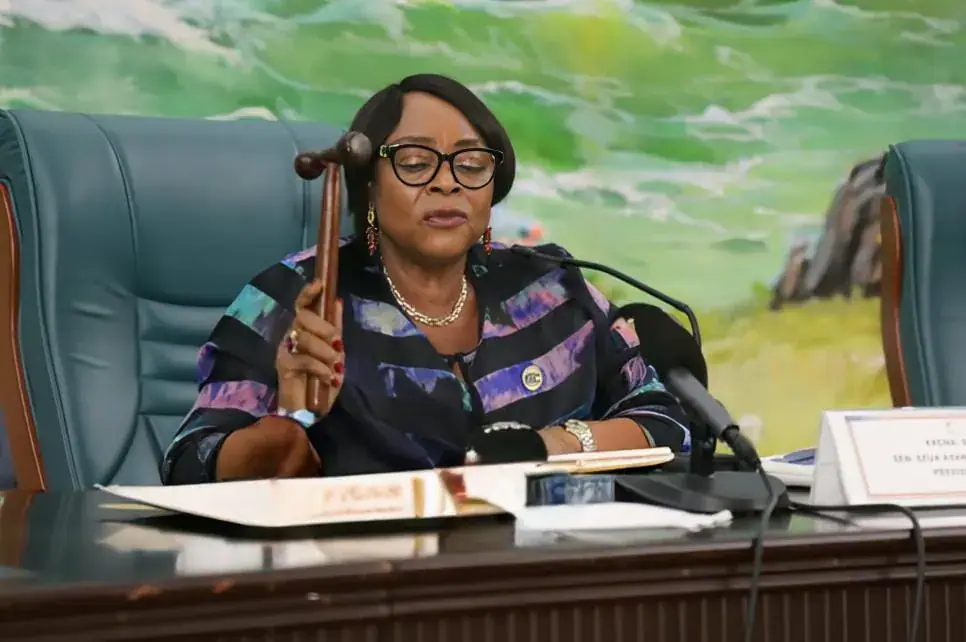
The Senate of Equatorial Guinea has approved the new Mining Law, a key piece of legislation designed to modernize the sector's regulatory framework and accelerate national economic diversification. The approval took place during the second ordinary session of the Senate, held in Bata. The law aims to adapt Equatorial Guinea's legislation to international standards of competitiveness, transparency, and sustainability.
The approval of the law was welcomed by various parliamentary groups and the government delegation, who see it as a decisive step towards transforming the country's subsurface into tangible benefits for its citizens. Nostriano Afugu Angue, spokesperson for the Coalition Democratic parliamentary group, justified their favorable vote by highlighting the need for this transformation. His group pledged to maintain a firm oversight role during the law's implementation phase.
The ruling Democratic Party of Equatorial Guinea (PDGE) also supported the initiative, considering it in line with the government's political program endorsed by the electorate. Leoncio Feliciano Esono Nze emphasized the urgency of revitalizing the sector to become a sustainable growth engine and drive industrialization. The new law is structured around five key axes, including critical minerals and energy transition, legal and fiscal framework, and environmental transparency.
The Minister Delegate of Hydrocarbons, Mines, and Electricity, Domingo Mba Esono, thanked the Senate for its rigorous analysis and outlined the law's main components. These include regulations on critical minerals such as lithium, cobalto, and rare earths, as well as provisions for contractual security, fiscal balance, and mandatory national content. The law also emphasizes transparency and environmental closure, with measures like digital geological registration and public concession processes.
The Ministry of Hydrocarbons, Mines, and Electricity has committed to submitting mining contract models to the Senate and providing regular updates on the law's implementation. This move aims to ensure accountability and transparency in the sector. The Senate's approval of the law marks a significant step towards enhancing governance and sustainability in Equatorial Guinea's mining sector.
The President of the Senate expressed her gratitude to all senators for their work on the law and to the delegation from the Ministry of Hydrocarbons, Mines, and Electricity. She congratulated them on the successful outcome of the second reading of the project. The new mining law is expected to play a crucial role in Equatorial Guinea's economic diversification efforts and in promoting a more transparent and sustainable mining sector.
The implementation of the law will be closely monitored by the Senate and other stakeholders, who expect it to bring about significant improvements in the sector. With its focus on transparency, accountability, and sustainability, the new mining law has the potential to transform Equatorial Guinea's mining industry and contribute to the country's economic growth and development.
Key points
- The new mining law aims to adapt Equatorial Guinea's legislation to international standards of competitiveness, transparency, and sustainability.
- The law is structured around five key axes, including critical minerals and energy transition, legal and fiscal framework, and environmental transparency.
- The Ministry of Hydrocarbons, Mines, and Electricity has committed to submitting mining contract models to the Senate and providing regular updates on the law's implementation.