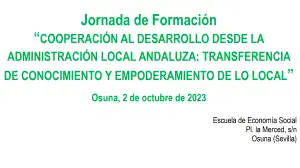
The Centro Cultural Hispano-Guineano recently hosted a training session titled "Cooperation for Development from Andalusian Local Administration: Transfer of Knowledge and Empowerment of the Local." The event aimed to promote cooperation between Spain and Equatorial Guinea on sustainable development and poverty reduction. Spain's cooperation policy is guided by the principles of the 2030 Agenda, which seeks to leave no one behind in the pursuit of sustainable and equitable development.
The training session brought together experts and officials from Andalusia and Equatorial Guinea to discuss the challenges and opportunities of cooperation for development. The Andalusian regional government has committed to the Sustainable Development Goals (SDGs) and is actively working to reduce poverty and promote development globally. The session covered topics such as the international cooperation system, the Andalusian cooperation model, and the role of local entities in promoting development.
The cooperation between Spain and Equatorial Guinea is framed within the recent Law on Cooperation for Sustainable Development and Global Solidarity, the Master Plan of Spanish Cooperation, and the III Andalusian Plan of Cooperation for Development 2020-2023. These frameworks provide a comprehensive approach to cooperation, focusing on issues such as governance, innovation, and financing. The training session aimed to strengthen the capacities of local entities in Equatorial Guinea to design and implement development projects.
The event also addressed the importance of education for development and humanitarian action. Participants discussed the role of local cooperation in promoting development and reducing poverty. The session included case studies and practical exercises to illustrate successful experiences in cooperation and development.
The Andalusian Agency for International Cooperation and Development (AACID) plays a key role in promoting cooperation between Andalusia and Equatorial Guinea. The agency's priorities include geographic targeting, transversal principles, and cooperation with local entities. The AACID also provides technical assistance and accompaniment to programs and projects.
The new Spanish Law on Cooperation for Sustainable Development and Global Solidarity sets out the framework for future cooperation efforts. The law emphasizes the importance of local entities and decentralization in promoting development. The upcoming Andalusian Plan of International Cooperation for Development (2024-2027) will build on the experiences and lessons learned from previous cooperation efforts.
The training session was organized by the Andalusian Federation of Municipalities and Provinces, in collaboration with the Centro Cultural Hispano-Guineano. The event was held online and in-person at the Escuela de Economía Social in Osuna, Spain. Further information can be obtained from the Federation's website.
Key points
- The cooperation between Spain and Equatorial Guinea focuses on sustainable development and poverty reduction.
- The Andalusian regional government is committed to the Sustainable Development Goals (SDGs) and is actively working to reduce poverty and promote development globally.
- The training session aimed to strengthen the capacities of local entities in Equatorial Guinea to design and implement development projects.