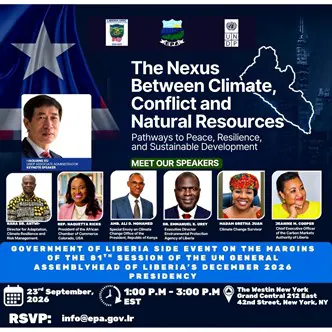
The Environmental Protection Agency of Liberia (EPA) hosted a high-level diplomatic dialogue in New York on the sidelines of the 81st Session of the United Nations General Assembly (UNGA). The event, titled "The Nexus between Climate, Conflict, and Natural Resources: Pathways to Peace, Resilience, and Sustainable Development," brought together global leaders, development partners, and climate negotiators. The dialogue aimed to explore the interconnectedness of climate change, conflict, and natural resource management, and to identify pathways to peace, resilience, and sustainable development.
The dialogue coincides with Liberia's 2026-2027 term as a non-permanent member of the United Nations Security Council (UNSC), where the country has committed to promoting a just and peaceful world. Liberia is using its diplomatic presence at the Assembly to demonstrate how environmental stewardship and natural resource governance can serve as foundations for peacebuilding. The gathering also underscores Liberia's alignment with major multilateral environmental agreements, including the Paris Agreement, the United Nations Framework Convention on Climate Change (UNFCCC), the Convention on Biological Diversity (CBD), and the United Nations Convention to Combat Desertification (UNCCD).
The event featured a keynote address by United Nations Under-Secretary-General Haoliang Xu, Associate Administrator of the United Nations Development Programme (UNDP). Xu's address, titled "Climate Change as a Threat Multiplier and Global Security Imperative," highlighted the critical linkages between climate change, conflict, and security. The program also included a documentary on Liberia's natural capital, showcasing the country's forests, rivers, and landscapes that sustain livelihoods across all 15 counties.
A high-level panel on global, regional, and national trends followed, moderated by Francine Pickup, UNDP Deputy Assistant Administrator and Deputy Director of its Bureau for Policy and Programme Support. The panel brought together voices from international governance, climate finance, diaspora investment, and grassroots experience. Panelists included Dr. Ali Daud Mohamed, Kenya's Special Envoy for Climate Change, and Antwi-Boasiako Amoah, Chair of the African Group of Negotiators (AGN) and Director for Adaptation, Climate Resilience and Risk Management at Ghana's Environmental Protection Authority.
The panel discussion was complemented by a personal testimony from Oretha Juah Bestman-Yates, a Liberian climate change survivor, who shared her experiences on how climate change is affecting the lives and livelihoods of ordinary Liberians. The program concluded with a roundtable discussion where each panelist offered one practical recommendation for world leaders, development partners, and investors. A question-and-answer session with participants followed, providing an opportunity for further engagement and exchange.
According to the EPA, Liberia's forests, rivers, minerals, and coastline support families and communities in every county. The agency hopes to share Liberia's experience, learn from partners across Africa and beyond, and encourage collaboration that helps turn climate challenges into shared opportunities for peace and prosperity. The EPA also aims to mobilize the climate finance needed to reduce the country's environmental vulnerabilities.
As Liberia's principal environmental regulator, the EPA is responsible for pollution control, biodiversity conservation, climate resilience, and sustainable natural resource management. The agency leads Liberia's implementation of multilateral environmental agreements, including the UNFCCC and the Paris Agreement through the country's Nationally Determined Contributions (NDCs). The EPA's efforts to host this high-level dialogue demonstrate Liberia's commitment to addressing climate change and promoting sustainable development.
Key points
- The EPA's dialogue at the UNGA highlights Liberia's commitment to addressing climate change and promoting sustainable development.
- The event brought together global leaders, development partners, and climate negotiators to explore the interconnectedness of climate change, conflict, and natural resource management.
- Liberia's experience in managing its natural resources and addressing climate change can serve as a model for other countries in the region.