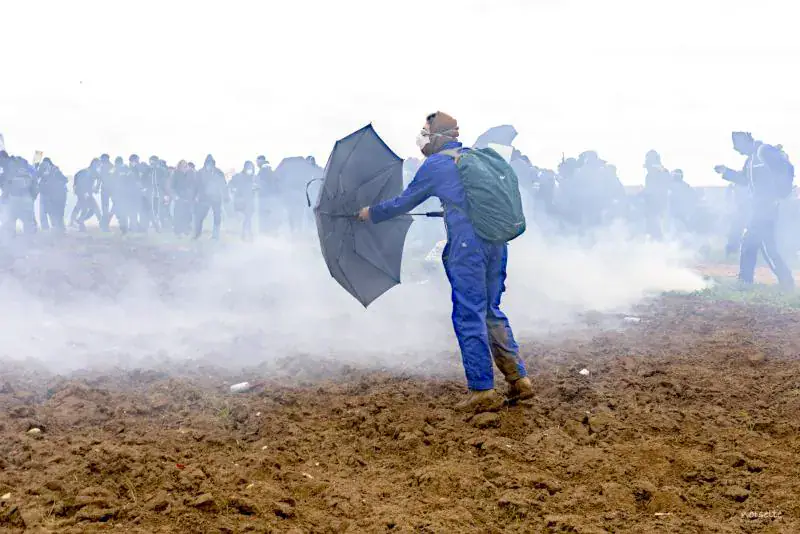
Historian François Jarrige has published a book titled "Verts de rage !" which explores the history of environmental struggles over the past two centuries. In an interview with Le Radical, Jarrige discussed the importance of understanding these movements as part of a larger continuum. He noted that events like Sainte-Soline, the Sivens dam, and Notre-Dame-des-Landes are often seen as isolated incidents, but they are part of a long history of environmental activism. Jarrige's book aims to provide a historical context for these struggles.
Jarrige's book begins with the episode of Sainte-Soline in 2023, which he believes marks a radical turning point in environmental activism. He argues that the dominant narratives of environmental history often suggest that ecological politics emerged in the 1960s and 1970s, but this narrative is overly simplistic. Instead, Jarrige contends that environmental struggles have existed throughout history, with various groups fighting to preserve their living conditions and protect the environment from pollution and degradation.
The 1970s were a pivotal moment in the development of environmental politics, according to Jarrige. This was a time when the term "environment" began to gain traction, and the Ministry of Environment was created in France. The creation of organizations like Greenpeace and Les Amis de la Terre also marked an important shift towards a more politicized environmental movement. Jarrige notes that this period saw a significant increase in environmental awareness, with major scandals like oil spills and industrial accidents drawing attention to the issue.
Jarrige identifies the first environmental struggles as dating back to the early 19th century. He cites the example of peasants in the Marseille region who opposed the construction of soda factories and chemical plants in 1809-1810. These movements led to changes in regulations, including the adoption of a decree in 1810 that aimed to regulate polluting industries. Jarrige argues that these early struggles demonstrate that environmental activism has a long history that predates the modern environmental movement.
The example of the Landes forest, which was planted to meet economic needs, reveals the logic of exploitation that underlies certain landscapes. Jarrige notes that the forest is one of the major environmental issues of the 19th century, which saw widespread deforestation. Two dominant logics emerged during this period: reforestation and optimization through scientific forestry. The conflict over the Fontainebleau forest in 1872-1873 illustrates the tension between these approaches, with foresters pushing for clear-cutting and replanting, while artists and conservationists opposed these plans.
The work of George Sand, a prominent writer and environmentalist, highlights the importance of preserving natural areas like the Fontainebleau forest. Sand's manifesto for environmental protection, published in the 19th century, demonstrates that concerns about the environment have been around for centuries. Jarrige's book aims to provide a historical context for these struggles, demonstrating that environmental activism is not a new phenomenon, but rather a long-standing movement that has evolved over time.
Jarrige's work emphasizes the importance of understanding environmental struggles as part of a larger historical context. By examining the past two centuries of environmental activism, Jarrige's book provides a nuanced understanding of the complexities of environmental politics. His work highlights the need for a long-term perspective on environmental issues, recognizing that the struggles of the past continue to shape our understanding of environmental protection today.
Key points
- Environmental struggles have a long history that predates the modern environmental movement.
- The 1970s were a pivotal moment in the development of environmental politics, with the creation of the Ministry of Environment and the emergence of organizations like Greenpeace.
- Understanding environmental struggles as part of a larger historical context is essential for developing effective environmental policies.