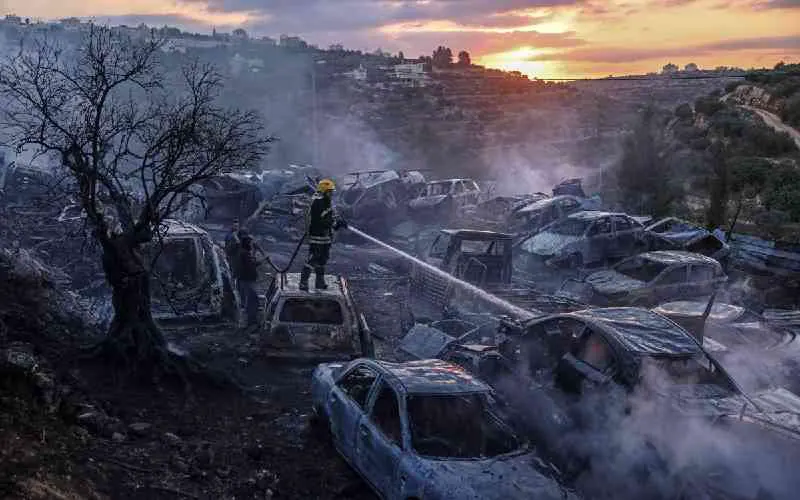
The ongoing Israeli attacks on Gaza have resulted in substantial environmental devastation, often treated as secondary to the human cost of conflict. However, in Gaza, the destruction of the environment is inextricably linked to the destruction of Palestinian life. The United Nations has documented deaths, injuries, displacement, and severe restrictions on life in the territory since October 2025.
A 2025 assessment by the United Nations Environment Programme found that 97 per cent of Gaza's tree crops, 95 per cent of its shrubland, and 82 per cent of its annual crops had been damaged since October 2023. Military activity has compacted and degraded soil, reducing its capacity to absorb water, increasing runoff and flooding risks, and diminishing groundwater recharge.
Gaza's freshwater systems have been severely damaged and contaminated, while its coastline and marine ecosystems have been affected by sewage, solid waste, and munitions. The olive tree, a symbol of Palestinian culture and heritage, has been specifically targeted, with research documenting patterns of uprooting, burning, poisoning, and cutting of olive trees by Israeli soldiers.
The destruction of Palestinian olive trees is part of the "genocide-ecocide nexus," a relationship between environmental destruction and the destruction or displacement of a people. This destruction undermines not only livelihoods but also the cultural and social foundations of a community. The environmental costs of political and economic decisions are disproportionately borne by poor, racialized, and politically marginalized communities.
Gaza demonstrates an extreme version of this principle, with a population having limited political and territorial power being left with destroyed agricultural land, contaminated water, toxic debris, and an ecosystem that will require generations to restore. In contrast, the decisions to destroy these communities are made by the most powerful, often by the United States and its allies.
The United States Department of Defence is the world's largest institutional consumer of fossil fuels and one of the world's largest institutional greenhouse-gas emitters. Research estimates that the US military emitted approximately 1.2 billion tonnes of greenhouse gases between 2001 and 2017, with more than 400 million tonnes directly attributable to war-related fuel consumption.
This raises questions for the international climate movement about how governments can speak seriously about reducing emissions while treating warfare, militarization, and weapons production as an almost entirely separate category. Environmental justice cannot be meaningful if the destruction of an ecosystem during war is considered merely collateral damage. The international community must consider the environmental costs of conflict and the role of military-industrial systems in consuming extraordinary quantities of fossil fuels.
Key points
- Environmental destruction caused by war is inseparable from the destruction of human life.
- The international community must consider the environmental costs of conflict.
- Military-industrial systems consume extraordinary quantities of fossil fuels, contributing to greenhouse gas emissions.