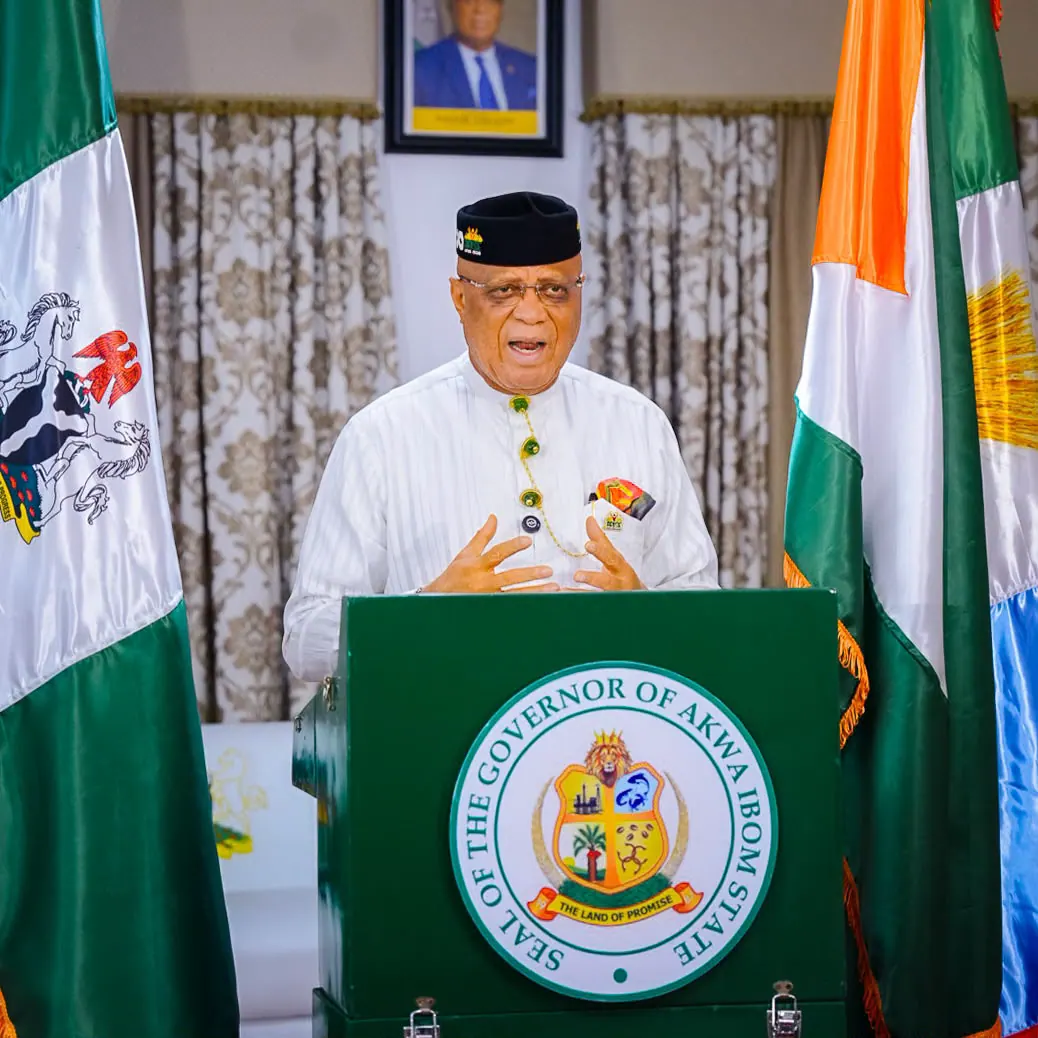
Governor Umo Eno of Akwa Ibom State has announced that the next phase of his administration's development agenda will prioritize industrialisation, agro-industrialisation, and job creation. In his anniversary broadcast to Akwa Ibomites, Eno stated that the state can no longer measure development solely by infrastructure provision. He emphasized the need to convert existing infrastructure and human capital into productive economic activity. The new direction, under the proposed ARISE 2.0, aims to transition the state from infrastructure to industrialisation, agriculture to agro-industrialisation, and skills to enterprise.
Eno highlighted that the state's development trajectory under ARISE 2.0 will focus on transforming Akwa Ibom's tourism potential into a functioning tourism economy and human capital development into a knowledge economy. The ultimate objective is to achieve shared prosperity. He stressed that the transition is necessary as Akwa Ibom enters the next chapter of its development at 39. The state must build an economy capable of creating opportunities beyond government-funded projects. Eno emphasized that government can provide the platform, but citizens must build the future.
Since May 29, 2023, Eno's administration has undertaken, commissioned, or continued over 1,500 kilometres of roads and 43 bridges. These projects aim to connect rural communities to markets, schools, healthcare, and investment opportunities. The governor stated that the administration deliberately took infrastructure to rural communities because "no community is too remote to matter." He linked the massive road programme to his broader objective of expanding economic opportunity across the state.
Eno's administration has also made significant investments in education. The state has disbursed N1.69 billion in bursaries, recruited 3,000 teachers, and sustained free and compulsory education. Plans are underway to transform the Akwa Ibom College of Education, Afaha Nsit, into a university of education. Eno described human capital as the state's most valuable resource, insisting that the future economic transformation of Akwa Ibom depends on the quality of its people.
The governor's youth interventions have also been a key focus area. Over 4,000 youths have received training through IBOM-LED and DASAC, while over N2 billion has been disbursed through skills development, entrepreneurship, and grants. Eno's administration is developing youth-friendly centres to channel young people into technology and the creative industries. The goal is to enable them to learn, create, build, invest, and prosper within the state.
Agriculture will also play a major role in the next phase of development. 1,700 farmers have already received grants, and the government is pursuing the acquisition of hundreds of thousands of oil-palm seedlings under its tree-crop revolution. Eno emphasized that the land must feed the people, farmers must prosper, and young people must see agriculture as a business, not a punishment. Reliable electricity is also critical to the proposed economic transition.
Eno reaffirmed his administration's commitment to the Ibom Deep Seaport, describing it as a potential economic gateway for trade, industry, logistics, jobs, and investment. The state is also positioning Ibom Air and its international airport facilities to support Akwa Ibom's ambition of becoming an aviation and economic hub in the South-South. At the social protection level, over 500 units have been completed and handed over under the ARISE Compassionate Homes initiative. Over N98 billion has been paid from approximately N111 billion in inherited gratuities and other obligations to retirees.
Key points
- Akwa Ibom State is shifting its development focus from infrastructure provision to industrialisation, agro-industrialisation, and job creation under the proposed ARISE 2.0 vision.
- The state's development agenda aims to transform Akwa Ibom's tourism potential into a functioning tourism economy and human capital development into a knowledge economy.
- Governor Eno emphasized the need for citizens to convert public infrastructure and opportunities into productive ventures to drive sustainable prosperity.