On October 6, 1973, Egyptian forces launched a coordinated attack along the Suez Canal, supported by air and artillery firepower. The operation, described by the Egyptian General Information Authority, involved breaching the canal and destroying Israeli fortifications, known as the Bar-Lev Line. The Egyptian engineers played a crucial role in the operation, tasked with creating pathways through the sandy berms and establishing bridges and ferries.
The initial stage of the operation involved infantry units crossing the canal using rubber boats, securing the eastern bank and paving the way for engineers to deploy equipment, including water pumps. These pumps were used to erode the sandy berms, creating pathways for heavy equipment to follow. According to the Egyptian General Information Authority, 350 water pumps were used to open 60 pathways within eight hours.
The sandy berms, part of Israel's defensive system, posed a significant obstacle, with heights reaching up to 25 meters in some areas. The Egyptian engineers, led by Major General Baki Zaki Yousri, utilized their expertise to devise a solution. By directing water jets at the berms, they successfully breached the defensive barrier, allowing for the passage of troops and equipment.
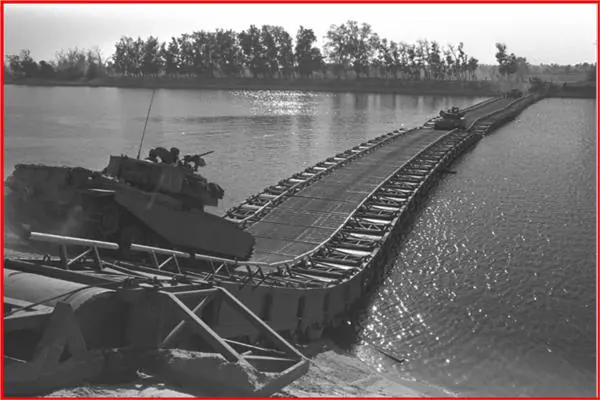
As the pathways were being created, engineers worked simultaneously to establish bridges and ferries, enabling the transportation of tanks and heavy equipment across the canal. The Egyptian forces successfully opened 60 pathways, constructed eight heavy bridges, four light bridges, and 30 ferries, facilitating the transfer of troops and equipment to the Sinai Peninsula.
The water pumps used by the Egyptian engineers were British-made, according to a study published in the US Army's Military Review. The study described the operation as a remarkable example of breaching a water barrier followed by a defensive trench under enemy fire. The Egyptian engineers' innovative use of water pumps and other equipment enabled the successful execution of the crossing.
The ferries and bridges played a vital role in the operation, providing a continuous route for large numbers of tanks, vehicles, and heavy equipment to cross the canal. As the equipment was being transported, the Egyptian forces continued to expand their presence on the eastern bank, ultimately achieving their objective of breaching the Bar-Lev Line and crossing the Suez Canal.
The successful crossing of the Suez Canal marked a significant turning point in the 1973 Arab-Israeli War, demonstrating the Egyptian military's capabilities and strategic planning. The operation showcased the critical role of engineers in modern warfare, highlighting their expertise in overcoming complex obstacles and enabling the rapid deployment of troops and equipment.
Key points
- Egyptian engineers used 350 water pumps to breach the sandy berms along the Suez Canal, creating 60 pathways within eight hours.