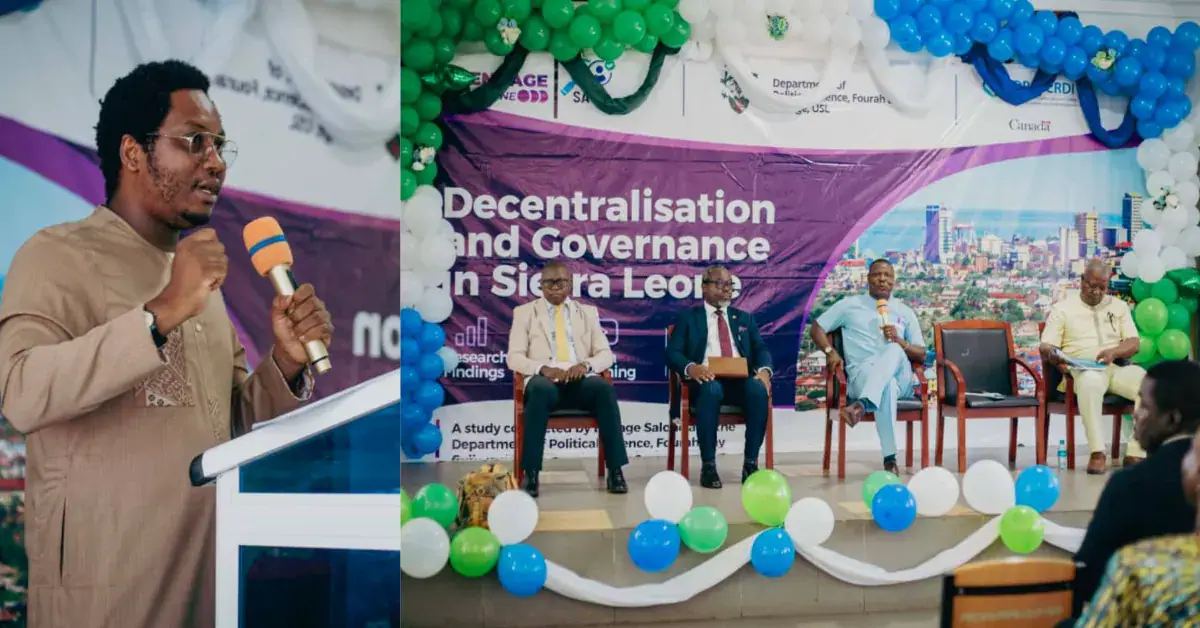
Engage Salone has released a research report examining decentralisation and local governance in Sierra Leone, revealing ongoing challenges. The report, based on a survey of 1,489 respondents across six council areas, found that decentralisation remains incomplete, with inadequate funding, weak institutional capacity, and limited public participation affecting its implementation. The study showed that local councils scored an average of 29.8 out of 100 in performance, despite citizens expressing moderate satisfaction with basic public services.
The research highlighted significant gaps in citizen participation and engagement in local decision-making. Sixty per cent of respondents stated that their local councils never consult communities, while only 17 per cent had attended a council meeting. These findings point to a lack of involvement from citizens in local governance. Inadequate funding, weak coordination between central and local government, limited institutional capacity, and political interference were identified as major barriers to effective decentralisation.
The report also raised concerns about the involvement of women in community governance and the responsiveness of local councils during emergencies, such as flooding. Despite these challenges, 55 per cent of respondents supported giving local councils more powers and increased funding, reflecting public support for strengthening local governance. This suggests that citizens are eager for more effective and empowered local councils.
Presidential Advisor Dr Emmanuel Ngaima presented a paper titled “Decentralisation and Governance: Reflections from a Pioneering Voice on Post-Conflict Decentralisation in Sierra Leone,” tracing the country’s decentralisation journey from 1972 to the present. He highlighted the 2004 reforms, which reintroduced elected local councils and transferred key responsibilities from central government to local authorities. Dr Ngaima acknowledged progress in health, education, agriculture, and accountability but noted that challenges persist.
Dr Ngaima called for stronger local government institutions, improved revenue mobilisation, effective resource allocation, policy reviews, and greater collaboration among stakeholders. He emphasised that decentralisation requires adequate resources, stronger accountability, and meaningful community participation to achieve its intended objectives. Engage Salone Executive Secretary, Edward Kargbo, urged the media to play a stronger role in national development, contributing to research, accountability, and policy reform.
The Deputy Registrar of Fourah Bay College highlighted the importance of strengthening partnerships between universities and civil society organisations to advance decentralised governance and evidence-based policymaking. Dr Mahmoud Tarawally discussed the need for stronger academic collaboration and mentorship to improve research output and address challenges facing university researchers. The discussions underscored the importance of connecting academic research, media engagement, and public policy.
The report’s findings and discussions highlighted the need for renewed commitment to decentralisation, improved institutional capacity, stronger local government financing, and greater citizen participation. The launch emphasised that evidence generated through research should contribute to improved governance and development outcomes across Sierra Leone. Key stakeholders must collaborate to address the challenges and ensure effective decentralisation.
Key points
- Inadequate funding and weak institutional capacity remain major barriers to effective decentralisation in Sierra Leone.
- Citizens express moderate satisfaction with basic public services but demand more involvement in local decision-making.
- Strengthening partnerships between universities and civil society organisations is crucial for advancing decentralised governance and evidence-based policymaking.