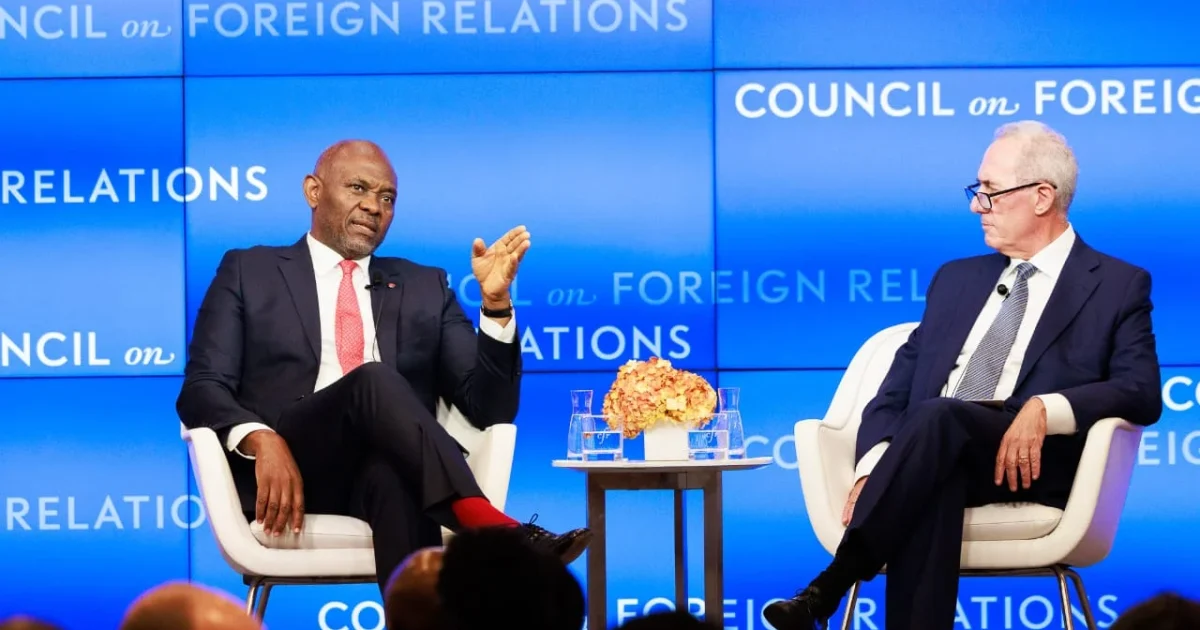
Nigerian businessman Tony Elumelu has called for a fundamental shift in U.S.-Africa relations, urging global investors and international policy partners to replace traditional aid dependency with private-sector-led commercial partnerships. Speaking during a fireside chat on the sidelines of the 81st United Nations General Assembly (UNGA) in New York, Elumelu argued that sustainable economic growth on the continent must be driven primarily by African trade, entrepreneurship, and domestic private capital. This address was part of the Council on Foreign Relations' Darryl G. Behrman Lecture on Africa Policy.
Elumelu challenged the persistent global perception of Africa as an aid-dependent region facing uniform financial risks. He stated that treating Africa as a monolithic, high-risk entity overlooks the immense economic dynamism across its 54 distinct nations. According to Elumelu, foreign entities can unlock some of the world's highest commercial returns by establishing strategic co-investment partnerships with credible local enterprise leaders who understand the market. This approach, he believes, can help change the narrative around Africa's economic potential.
Reaffirming his commitment to Africapitalism, Elumelu noted that while foreign aid offers short-term relief, it cannot construct sustainable industrial infrastructure or replace the structural impact of domestic private investment. He urged international venture funds, pension managers, and development finance institutions to partner directly with local African financial institutions to help finance energy corridors and core trade hubs. This, he believes, can help drive economic growth and development on the continent.
Elumelu emphasized the connection between economic development and national security, describing young African entrepreneurs as a vital pillar of global stability. He cautioned that unaddressed youth unemployment directly accelerates irregular migration and social unrest. The Tony Elumelu Foundation has committed $100 million to train and fund young African entrepreneurs, demonstrating how $5,000 in non-refundable seed capital can stimulate widespread job creation across urban and rural communities.
Turning to climate policy and infrastructure, Elumelu urged global leaders to adopt a pragmatic approach to Africa's energy transition. Noting that more than 600 million Africans currently lack access to basic electricity, he argued that discussions around industrial growth or digital scaling are impossible without consistent power generation. Elumelu believes that Africa must be allowed to use its abundant natural gas reserves as a critical transition fuel to power local industries and stabilize electricity grids.
Elumelu called for modernizing current commercial frameworks, including the African Growth and Opportunity Act (AGOA), to focus directly on reducing production and freight costs for African exports. He added that as implementation of the African Continental Free Trade Area (AfCFTA) progresses, future international arrangements should focus on deepening supply-chain integration, expanding local manufacturing capacity, and eliminating regulatory barriers to intra-African commerce.
Elumelu concluded the lecture by reminding attendees that boosting prosperity across Africa serves broader international security interests. He stated that "poverty anywhere remains a direct threat to economic peace and security everywhere." The lecture was moderated by President Michael Froman, and it formed part of the Council on Foreign Relations' efforts to shape policy discussions around Africa's economic development.
Key points
- Elumelu urges global investors to adopt a private-sector-led approach to drive sustainable economic growth in Africa.
- He emphasizes the need for a pragmatic approach to Africa's energy transition, including the use of natural gas reserves.
- Elumelu calls for modernizing commercial frameworks, such as AGOA, to support African exports and economic growth.