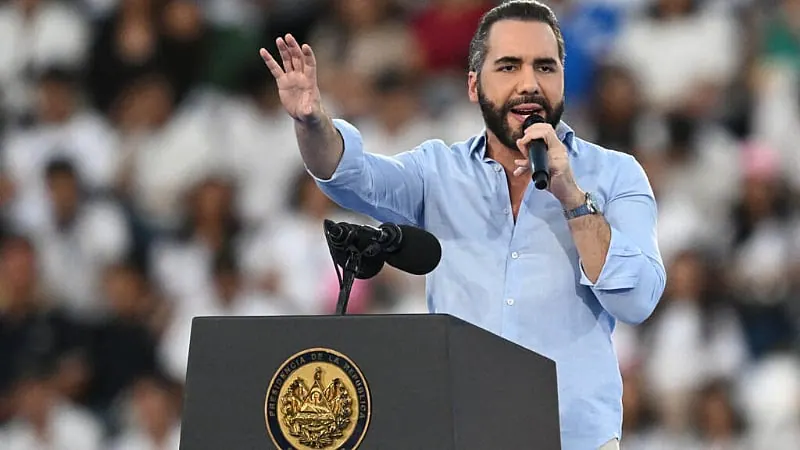
El Salvador's electoral tribunal has announced that the country will hold presidential elections on February 28, 2027. This development paves the way for President Nayib Bukele to seek a third term in office. Bukele has been in power since 2019 and has gained popularity for his tough stance on gangs. His administration's policies have led to a significant reduction in crime, but have also been criticized for alleged human rights abuses.
Last year, El Salvador amended its constitution to abolish presidential term limits, allowing Bukele to seek re-election indefinitely. The 45-year-old president won the nomination of his Nuevas Ideas party to run for a third term. If successful, this would extend his presidency until 2033 under new rules extending presidential terms from five years to six. Bukele's rise to power marked the end of three decades of alternating power between the Nationalist Republican Alliance (ARENA) and the Farabundo Marti National Liberation Front (FMLN).
Bukele's administration has been marked by a state of exception declared in 2022, which is still in effect. During this period, around 92,000 people, mostly young men, have been arrested and held, many without charge. The courts have begun holding mass trials to clear the legal backlog. While Bukele's policies have reduced crime to historic lows, NGOs have criticized his administration for widespread human rights abuses, including torture, that could constitute crimes against humanity.
Bukele has rejected allegations of human rights abuses and has made light of accusations of his authoritarian style, calling himself the "world's coolest dictator." His administration's tough stance on gangs has made him a hero to many in his homeland and across Latin America. However, his critics argue that his policies have come at the expense of democratic institutions and human rights.
Several candidates have announced plans to run against Bukele in the 2027 presidential election. Former congresswoman Maytee Iraheta, of the right-wing ARENA, and union leader Rafael Aguirre, of the left-wing FMLN, have already declared their candidacy. Bukele's Nuevas Ideas party is expected to be a major force in the election, but it remains to be seen whether his opponents can mount a credible challenge.
The 2027 presidential election will be a significant test of El Salvador's democratic institutions. While Bukele's policies have reduced crime, his administration's human rights record has raised concerns among international observers. The election will also be an opportunity for voters to assess the impact of Bukele's policies and decide whether to continue his leadership or choose a new direction.
The international community has been closely watching El Salvador's developments, with many organizations expressing concerns about the country's human rights situation. The outcome of the 2027 presidential election will likely have significant implications for El Salvador's relations with the international community and its future democratic development.
Key points
- El Salvador's electoral tribunal has scheduled the 2027 presidential election for February 28, 2027.
- President Nayib Bukele is seeking a third term in office after constitutional changes allowed him to run again.
- Bukele's administration has been marked by a significant reduction in crime, but also allegations of human rights abuses.