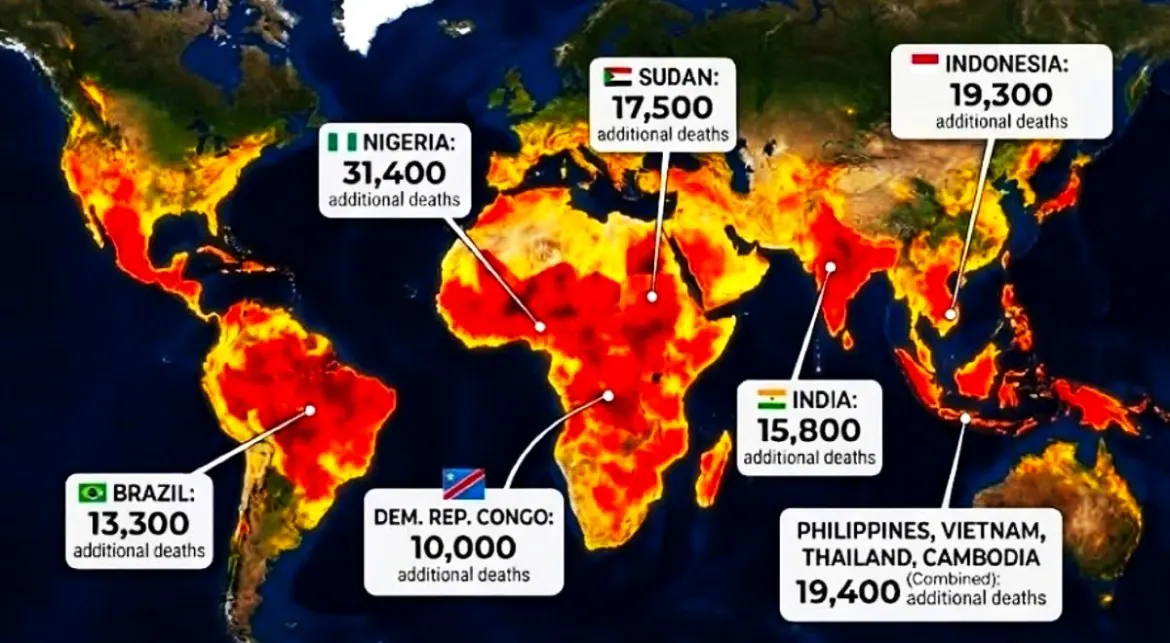
A recent report by the Climate Impact Lab warns that the impending El Niño heat wave could lead to 451,000 additional deaths worldwide between October 2026 and February 2027. This forecast is based on temperature predictions and methods that link temperature and mortality across thousands of regions. The report highlights that the threat is not limited to brief heat waves but also includes months of persistently higher temperatures that can cumulatively strain health.
The El Niño phenomenon is expected to cause land temperatures around the world to average roughly 2.1°F (1.2°C) above the 1996–2025 baseline in the coming months. This increase in temperature is attributed to the El Niño event, which is adding to temperatures already elevated by human-driven climate change. Researchers warn that the coming conditions could resemble those that global warming makes typical in roughly 20 years.
Africa is expected to be severely impacted by the El Niño heat wave, with the Democratic Republic of Congo, Nigeria, and Sudan predicted to suffer the most. In Nigeria, 31,400 additional deaths are projected, while in Sudan, 17,500 additional deaths are expected. The DR Congo is predicted to experience 10,000 additional deaths. These numbers are estimates and exclude additional deaths from floods, droughts, wildfires, and food shortages.
The report also projects significant death tolls in other parts of the world, including Indonesia, India, Brazil, and several Southeast Asian countries. Indonesia is expected to experience 19,300 additional deaths, while India is projected to see 15,800 additional deaths. Brazil and the Philippines, Vietnam, Thailand, and Cambodia are also expected to be severely impacted.
Researchers emphasize that targeted action could prevent tens of thousands of deaths. Earlier heat warnings, cooling centers, drinking-water access, outdoor-worker protections, and additional medical staffing could reduce the toll. The report's regional detail is intended to help governments direct resources where they could save the most lives.
El Niño is a natural climate phenomenon that occurs when waters in the central and eastern tropical Pacific become unusually warm. This event influences heat and rainfall far beyond the Pacific and can have devastating effects on global health. The Climate Impact Lab report's estimates concern heat and exclude additional deaths from other climate-related disasters.
The report's findings are based on a combination of temperature forecasts and methods linking temperature and mortality. While the report itself has not yet undergone peer review, environmental experts say its projections are concerning and warrant attention from governments and health organizations. The analysis provides a critical warning for governments to take proactive measures to mitigate the impact of the El Niño heat wave.
Key points
- The El Niño heat wave is predicted to cause 451,000 additional deaths worldwide between October 2026 and February 2027.
- Africa's DR Congo, Nigeria, and Sudan are among the countries expected to be severely impacted by the El Niño heat wave.
- Targeted action, such as earlier heat warnings and cooling centers, could prevent tens of thousands of deaths.