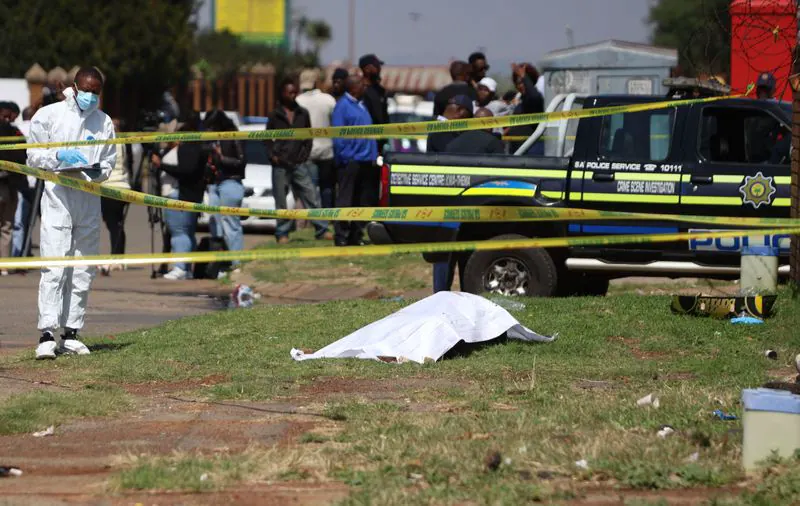
The recent killings of 11 women in Ekurhuleni and Soweto have intensified fears over South Africa's femicide crisis, exposing women's daily vulnerability and persistent failures in policing, prevention, and accountability. The victims include Elizabeth "Tsontso" Moselakgomo, 38, who was reported missing by her eight-year-old daughter on September 9 after failing to return home from her run. Her partially clad body was found in Rhodesfield, Ekurhuleni, and family members identified her on September 14.
The South African Police Service (SAPS) has appointed a task team to investigate the murders, suggesting similarities in their deaths, which has raised fears that they could be the victims of a serial killer. However, the police have cautioned against making such conclusions. The bodies of the 10th and 11th victims were discovered in Ekurhuleni at the weekend, with the first body found at Mooifontein Cemetery in Thembisa on Saturday, September 26. A suspect was arrested in connection with the murder after allegedly fleeing to Tzaneen, Limpopo.
In 2023/24, 3,422 women were murdered in South Africa, with many cases sparking public outrage and promises of urgent reform. President Cyril Ramaphosa said the killings had caused "fear and uncertainty" among women and communities, and the government shared their concerns. He directed that the cases be prioritized and that "no stone be left unturned" in bringing those responsible to justice. Ramaphosa emphasized that as a nation, South Africa must stand up for the rights, safety, and dignity of women and girls.
The SAPS has launched an intensified investigation, bringing together detectives from specialized units, including the Murder and Robbery Unit and Investigative Psychology Unit. The team also includes forensic and data specialists, fingerprint experts, intelligence officers, Home Affairs officials, and criminologists. Deputy National Police Commissioner Lieutenant General Tebello Mosikili said that addressing violence required cooperation beyond the police, pointing to issues such as poor lighting in secluded areas that fall outside the SAPS's mandate.
A R400,000 reward has been offered for information leading to arrests. In addition to the arrest made on Saturday, the police have arrested suspects in connection with another two of the killings. Busisiwe Mahlangu's partner was arrested in connection with her murder on July 17, two days after her body was discovered in an open field near the R21 highway in Kempton Park. Last weekend, three suspects, one man and two women, were arrested in connection with Jabulile Ntimba's murder.
Public safety warnings advising women to travel in groups and avoid exercising alone have sparked backlash for placing the burden of safety on women themselves. Ekurhuleni resident Cailyn Nienaber, 23, expressed concern that women are taught how not to become victims far more often than men are taught not to create them. Many women, including Katherine Elmer-English, 24, from Pietermaritzburg, and Jesse Smailes, 20, from Makhanda, shared their experiences of feeling vulnerable and frustrated with the current situation.
The Ekurhuleni murders have highlighted the need for a comprehensive approach to address the femicide crisis in South Africa. Former SAPS profiler Professor Gérard Labuschagne argued that investigators should treat the murders as serial killings until evidence shows otherwise. The experience of Achumile Nogampula, 22, from Makhanda, illustrates the impact of the killings on women's awareness of their safety and the need for a societal shift in addressing violence against women.
Key points
- The SAPS has appointed a task team to investigate the murders and offered a R400,000 reward for information leading to arrests.
- President Cyril Ramaphosa has directed that the cases be prioritized and emphasized the need for the nation to stand up for the rights, safety, and dignity of women and girls.
- The Ekurhuleni murders have sparked public outrage and highlighted the need for a comprehensive approach to address the femicide crisis in South Africa.