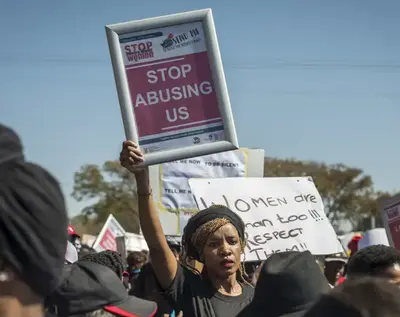
The recent discovery of nine women's bodies in Ekurhuleni, South Africa, has sent shockwaves through the nation, highlighting the ongoing struggle to address gender-based violence. The victims were found between July and September, with police investigating possible links between some of the cases. The latest victim, Jabulile Ntimba, was found in Dawn Park on September 17, and two women have been arrested in connection with her murder.
Advocates argue that the killings are not an isolated incident, but rather a symptom of a deeper issue – a failure of the criminal justice and support system to prevent violence, investigate cases, and support survivors. Advocate Bernadine Bachar, a board member of the National Shelter Movement of South Africa, emphasized that the onus of safety should not be placed solely on women. Instead, she argued that government departments and law enforcement agencies must take responsibility for protecting the public and ensuring that perpetrators are brought to justice.
The impact of gender-based violence extends beyond individual attacks, with women often living in a state of hypervigilance, constantly assessing threats and their safety in public and private spaces. Bachar noted that the state has failed on multiple fronts, including the implementation of legislation, the processing of forensic evidence, and the resourcing of shelters and organizations supporting survivors. Forensic kits, for example, can take months to process, while shelters and NGOs are often left to provide services that should be adequately supported by the state.
Princess Eurika Mogane, a commissioner at the Commission for Gender Equality (CGE), stated that the sequence of killings has shaken South Africans into confronting a level of violence that has become normalized. The CGE, together with the South African Human Rights Commission and the CRL Rights Commission, launched a joint inquiry in July into the reporting, victim support, investigation, and pre-trial handling of GBVF cases. The inquiry attracted a large response, with the submission deadline extended to September 11.
According to police statistics, 688 rapes were reported in Mpumalanga alone between April and June this year, including 332 involving children. Mogane noted that these figures do not capture violence that is never reported or cases that are withdrawn. The CGE is examining these issues, and Mogane emphasized that the focus should be on perpetrators and the wider society, rather than framing the crisis as a conflict between men and women.
The CGE is also concerned about the capacity of the forensic system, particularly DNA processing, which can affect the progress of sexual offence cases through the courts. Mogane stated that the commission is monitoring gender-based violence and femicide cases in court, with commissioners and its legal team observing proceedings and intervening when necessary. The commission's services are free, and Mogane encouraged victims to seek support.
Ultimately, advocates stress that the response to gender-based violence must go beyond declarations of concern, with the state properly resourcing shelters and NGOs, making policing visible, ensuring perpetrators are charged and prosecuted, and strengthening the criminal justice system. The shelter sector should not be left to carry out responsibilities that constitutionally belong to the state without adequate support. As Bachar emphasized, a concrete plan is needed to address the crisis, and it remains to be seen how the government will respond to the growing calls for action.
Key points
- The killings of nine women in Ekurhuleni have exposed a deeper failure of the criminal justice and support system to prevent violence, investigate cases, and support survivors.
- Advocates argue that the onus of safety should not be placed solely on women, but rather on government departments and law enforcement agencies to take responsibility for protecting the public.
- The Commission for Gender Equality is examining the reporting, victim support, investigation, and pre-trial handling of GBVF cases, and has called for a more proactive approach to addressing the crisis.